
Is your foresight stuck in handoffs? Do your leaders make strategic decisions based on the past? Let's get back to basics for a bit.
It’s Monday morning. A foresight team is finalizing a trend deck for an upcoming strategy session. The signals are strong. The analysis is thoughtful. The slides are polished.
By Friday, the presentation has been delivered, maybe discussed.
By next month, it’s rarely opened again. Conclusions remain undefined.
By next quarter, another team is scanning (again), often finding the similar patterns, from scratch. The cycle is continues.
By the end of the year, budget discussions begin. Cost-efficiency seems to be the only way forward, as if the growth opportunities identified by the foresight team never existed. Foresight results do not reach the decision-makers’ table, as they seem not to be needed. Forecasts do.
And so, we go again, repeating the cycle of business as usual. Calculating the benefits of every activity and making “hard decisions,” without seriously considering the opportunities provided by the foresight team.
What if the safe options are not reliable anymore? Uncertainty hardly rewards stillness.
What if, by using foresight results, we could move beyond the familiar path of “business-as-usual” and cost-cutting?
What if leaders were required to make strategic decisions instead of operational downsizing?
When it comes to foresight, nothing obvious is broken. And yet, something isn’t working right. So the question is not: “Why is our foresight weak?” but rather: “Why does good foresight work fail to be taken seriously? When did strategy become an operational game?”
The quiet problem: foresight that doesn’t create impact (or is not allowed to)
In many organizations, foresight exists. It produces outputs. It creates moments of insight. But it doesn’t find its way to those who need it, resulting in little impact.
-
It doesn’t move across teams,
-
It doesn’t stay alive between projects,
-
It doesn’t consistently reach decision-making contexts.
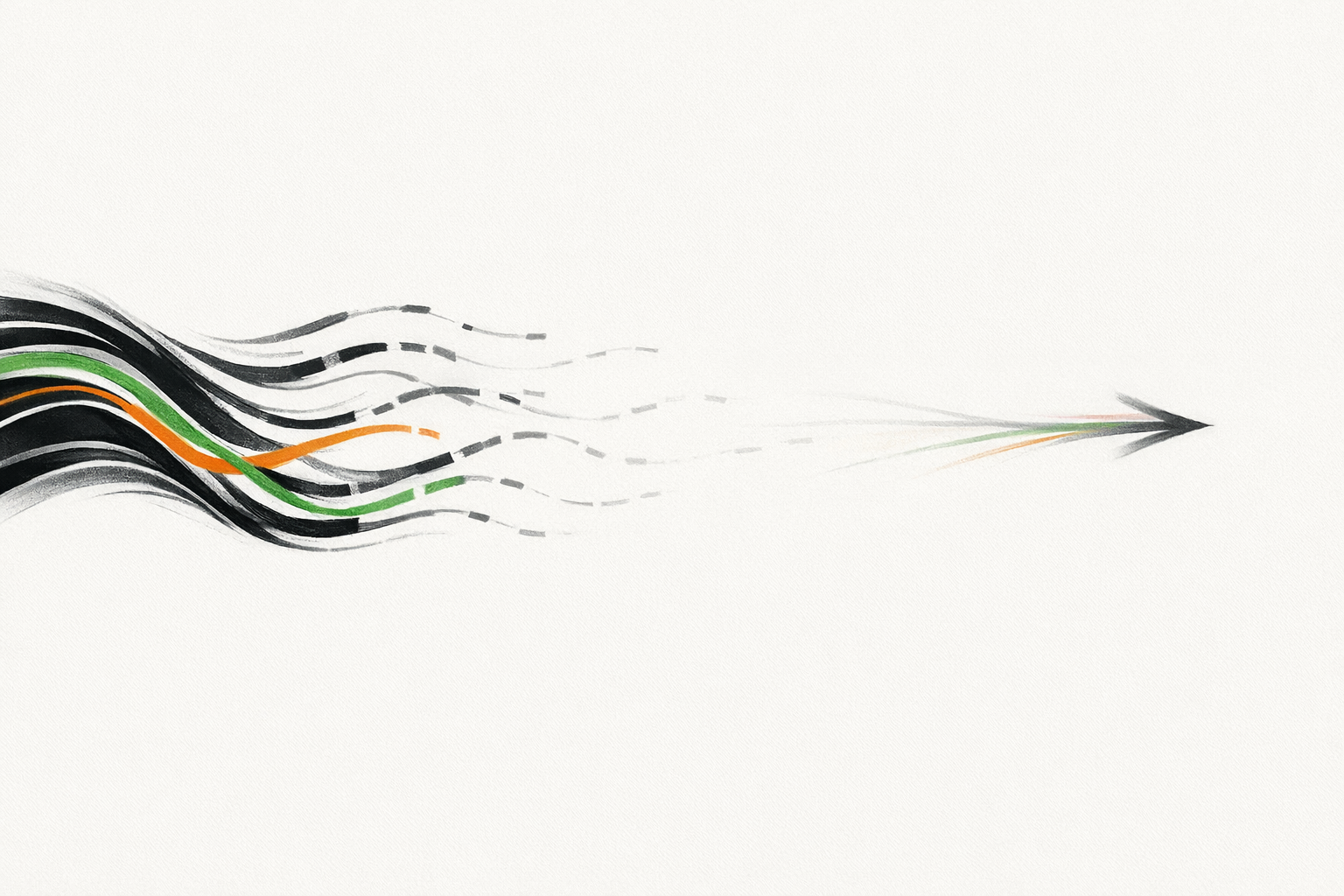
What I often see is not a lack of capability but a breakdown in continuity. Not broken foresight. Interrupted foresight.
First aid: Make foresight a continuous flow, the one keeping the eye on strategic issues:
Fragmentation happens easily and quickly. You are allowed to enjoy the fruits of your work: every report is a win, every discussion matters, but not for long without continuity. Futures intelligence accumulates over time through continuous, shared effort. Describe the basic steps of your foresight process. Refine the execution and design each year, but make sure all three aspects are taken into consideration:
-
Sensing: recognizing signals and changes,
-
Sensemaking: interpreting patterns and building shared understanding,
- Seizing: using the results in decision-making (Teece, 2007). Apply your foresight results, the understanding, in real choices: build outputs based on decision-makers’ needs, in the desired form, aligned with decision-making processes and rhythm, and as part of a habit.
“Future-prepared” firms (with foresight) outperform others in profitability (by 33%) and growth (200%), effectively improving long-term survival odds. Firms with foresight deficiencies face a 37%–108% performance decrease. Foresight systems can be described by three practices: Perceiving (identifying the factors that drive environmental change), Prospecting (sensemaking and strategizing), and Probing (experimental search and practical testing of new options) (Rohrbeck & Kum, 2018).
Successful firms structure innovation with clear responsibilities and priorities, combined with extensive communication and design freedom to enable improvisation of novelties: they are steady enough to work, but flexible enough to react to changes. Successful firms rely on a wide variety of low-cost probes into the future; they link the present and future together through rhythmic, time-paced transition processes (Brown & Eisenhardt, 1997).

To conclude, it is clear why we need foresight and which steps are suggested. Still, how to make it work in your organization requires tailoring and a deeper understanding of your foresight needs, decision-making processes, level of uncertainty, and timing.
There is no technical guidebook (yet) that gives every detail on how to build a foresight system. There is no law (yet?) requiring companies to have such a system in place. Science is not yet there to provide these answers, and governments are only beginning to recognize the need. Academics and practitioners are learning from the most successful examples, but those that succeed build systems tailored to their own context, making them not necessarily directly applicable to yours. It is a process of trial and error for long-term success, but it is vital, not optional.
Further aid: Create a habit of working with uncertainty, not avoiding it:
The system produces outputs, but it does not accumulate intelligence if it does not reach decision-making layers. Avoid friction in your foresight activities and normalize them as part of the organization’s usual processes:
Working with unknown
Continuously scan and collect novel signals so everyone interested can read them or take part in the activities. The foresight team is the only one with the mandate to explore a variety of futures that remain unknown to the majority of forecasting-reliant thinkers. Embrace this mandate, use it creatively based on your organisation’s foresight needs, and do not settle for general trend reports that do not explain how each signal might affect your organization.
Radaring changes
Reuse your weak signals, trends, wildcards, megatrends, and drivers. Share your findings with other teams. Share the trend library and updating responsibilities, and don’t let it remain the sole domain of the foresight team.
Futures-proofing
Facilitate stress-testing or wind-tunneling of new strategy: do not let business-as-usual planning ruin your long-term futures. Situations in which decisions are made based only on historical data, without considering foresight results, lead to a conscious self-disruption of your key foresight benefits and to questioning the role of foresight activities. This neither improves organizational performance nor avoids the familiar return to cost-cutting discussions.
It is dangerous to treat “risk” and “uncertainty” the same way. In the case of risk, behavior can be estimated and probabilities measured, while in the case of uncertainty, this is simply not possible (Knight, 1921). With risks, you can plan based on successful past events; with uncertainty, you can only build options for seizing opportunities.

We have been used to low uncertainty, which created a fertile ground for probabilistic thinking, but in the new reality of high uncertainty, survival starts with sensing environmental changes (Knight, 1921). High uncertainty can make incremental, steady growth harder, but it enables leaps and exponential growth, if you learn to work with it rather than trying to avoid it.
Recognize these 4 patterns of fragmented foresight early
Fragmentation rarely looks chaotic. It often looks organized until you look closer. Here are four patterns I repeatedly encounter:
1. The “single team bubble”
Foresight lives within a small group. Others receive outputs but don’t contribute, question, or build on them. Signals, notes, and insights live across slides, spreadsheets, inboxes, and personal files. The result: Insight stays local. No shared memory. No compounding knowledge. Ownership doesn’t spread.
Organize everything in one accessible place (platform or tool) and share both results and responsibilities. The basic task of spotting signals should be open to everyone who wants to keep up with change, and it should take no more than 10 minutes per week.
We all read news, we all have that feeling of “this is fresh!” or “this might cause a surprise effect!”, but the foresight team should make capturing these signals as easy as pressing a button: “saved & shared.”
2. The “presentation cliff”
Work culminates in a report or deck. After delivery, momentum drops sharply, and nobody takes care of how the foresight results are used. The result: Each cycle starts close to zero again.
When blamed for hard-to-demonstrate benefits of foresight, ask: How did you use the results we provided? How could we help you become a more effective user of foresight insights? In what form and time frame do you want the results? What are the key decision-making topics for the next year?
Based on the answers, build foresight that fits decision-making needs and keep a record of decisions influenced by foresight results.
3. The “silent leadership gap”
Leaders are interested, but foresight is not embedded in decision-making processes. The result: Insight exists, but influence is inconsistent.
When foresight is not taken seriously, use science, case examples, and quotes if needed (if you would like a list of suggestions, let me know: anna.grabtchak@fibresonline.com). The basic decision is: in the sea of rising uncertainty, as surfers, boats, or ships, do we want to search for the next wave for growth, or assume (naively) that one good wave will carry us the same way it did before?
4. The “manual loop”
Highly skilled people spend significant time collecting, formatting, and rebuilding work. The result: Less time for interpretation. Less strategic value.
Use AI for manual work: for summarization (where quality is easy to verify), for voting or rating (e.g. quantification), for organizing visual outputs (e.g. radar views or image generation), and for suggesting perspectives that help reduce human bias.
Individually, these are manageable. Together, they create a system where foresight is active, but not cumulative. If these topics seem difficult, the issue is unlikely to lie in your team’s foresight capabilities. It’s in the structure and mandate of your foresight.
What changes when foresight starts to flow
When foresight is connected across sensing, sensemaking, and decision-making, something shifts. Each quarter, you seem to have new ideas for testing: some fail, but others succeed. You start to feel like you are part of the change, not just observing it from the sidelines.
-
Signals don’t disappear, they accumulate: patterns begin to show their implications for your organization,
-
Trends don’t reset, they evolve: you start to distinguish which might be fads and which are developing into stronger trends.
-
Insights don’t sit in slides, they remain accessible: e.g. foresight discussions, futures wheel workshops, scenario-based stress testing or strategy wind-tunneling keep you actively engaged. The foresight team is no longer just a report-production machine, but also active in other processes.
-
Conversations don’t restart, they continue: you start to see how discussions flow into ideas, ideas into options, options into conceptualized opportunities, and opportunities into new budgets for practical testing. Test results then guide and shape options for larger, more ambitious moves.
-
The organization becomes steady enough to operate, but flexible enough to adapt and change based on opportunity. You might feel like working on topics that would drive other organizations into chaos or paralysis. (OK, this one might seem like utopia, but let’s have a brave vision once in a while).
This is not a content problem
When foresight struggles to create impact, the instinct is often to improve the content: better signals, better trends, better reports. But in many cases, the content is already strong.
… What’s missing is not quality. It’s continuity and the ability to work with uncertainty.
… And continuity is not created through more effort. It is created through how foresight work is structured, shared, and connected to decision-making.
… While the habit of working with uncertainty can only be mandated by leaders, foresight teams can teach it through the examples they set and the standards they build.
Hopefully this offers some support for futurists (often doing great work whose value is hard to quantify), for managers and directors facing budget constraints (where scarce resources must meet demanding targets), and for leaders (who feel that familiar approaches no longer work in a reality of rising uncertainty).
FIBRES contributes by supporting foresight flow and making daily work easier through collaborative human–AI assistance. Still, much is left for foresight teams to do. Sharing what works and what does not (based on the many strong examples I have worked with) may help guide others and bring some needed compassion to the work futurists are currently facing.
It is not easy, but futurists need to think about multiple possible and preferable futures in a world of permacrisis, because this is the only way to learn how to live within it.
If this resonates, feel free to book an online session with me for a personal walkthrough of our foresight platform and how it enables more impactful foresight.
References & some further reading
-
Brown, S. L., & Eisenhardt, K. M. (1997). The art of continuous change. Administrative science quarterly, 42(1), 1-34.
-
Rohrbeck, R., & Kum, M. E. (2018). Corporate foresight and its impact on firm performance: A longitudinal analysis. Technological Forecasting and social change, 129, 105-116.
-
Teece, D. J. (2007). Explicating dynamic capabilities: the nature and microfoundations of (sustainable) enterprise performance. Strategic management journal, 28(13), 1319-1350.