
The first sign you’ve outgrown manual foresight, and may need a foresight platform
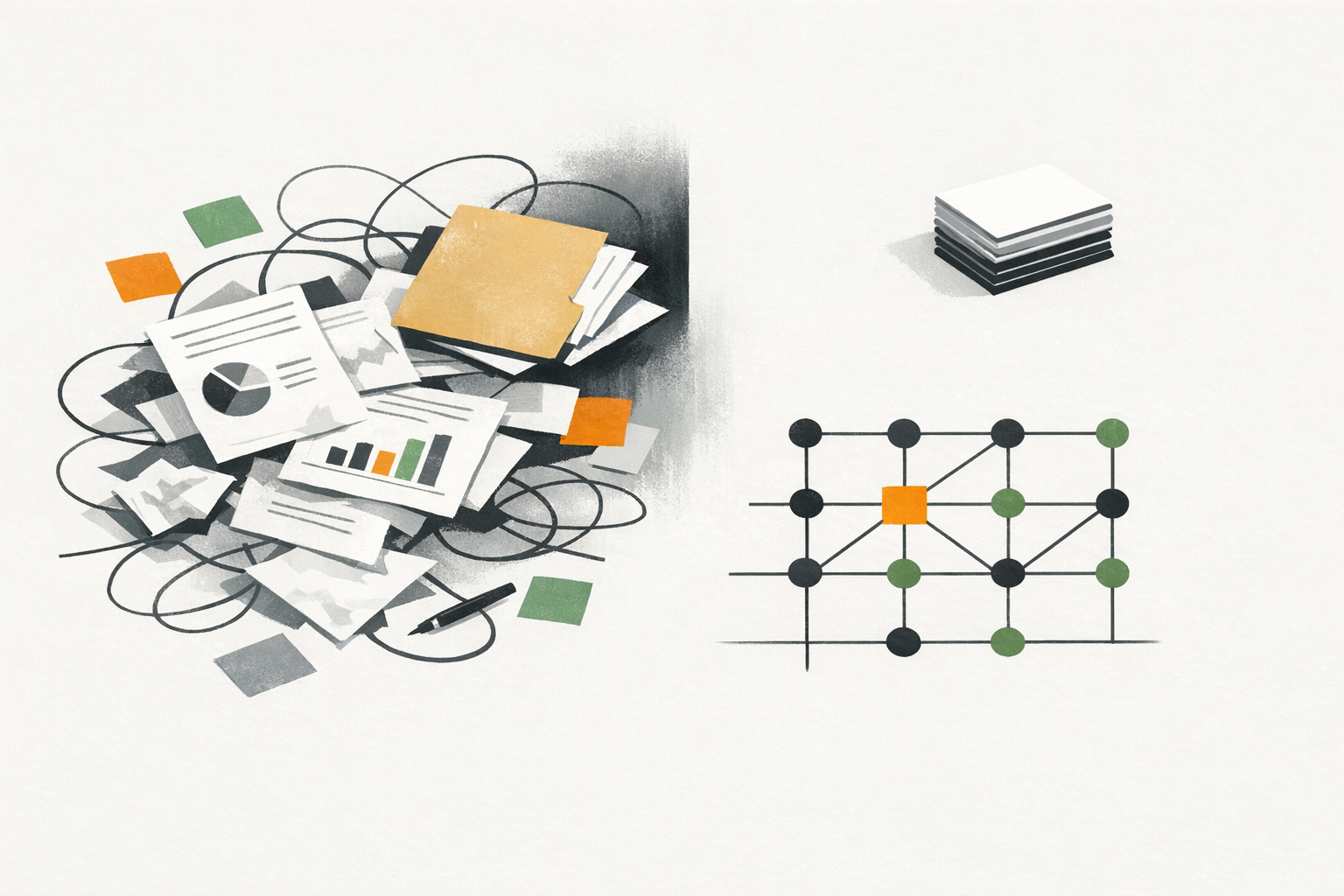
Most teams assume they will know when it is time to upgrade their foresight setup. They expect a dramatic moment: a missed disruption, a boardroom surprise, a strategic bet that aged badly. However, it is usually much quieter than that.
The first real signal is rarely about the quality of insights. It is about friction.
If you have ever spent half a workshop debating which deck is current, or searching for the source behind a promising trend slide, you are already paying what I tend to think of as a scale friction cost: the time and energy lost just keeping foresight work aligned.
Not intellectual friction, but operational friction. The kind that creeps in when more people join the work, more weak signals get collected, and staying aligned becomes a job in itself.
I have felt this firsthand. At first, spreadsheets and slide decks work just fine. They are flexible, familiar, and fast to spin up. But at a certain point, the same tools that once enabled progress start to quietly cap it.
Scale friction in horizon scanning: what it looks like
Scale friction shows up in small, almost boring ways:
-
Multiple versions of the “latest” file
-
Signals scattered across folders and drives
-
Unclear ownership of updates
-
Manual formatting eating into analysis time
-
Long meetings just to synchronize understanding
-
Teams building parallel tracking systems without realizing it
None of this feels dramatic. It just feels inefficient.
But taken together, these symptoms are telling you something important: your horizon scanning and strategic foresight process has outgrown the structure supporting it.
The work has become collaborative. Continuous. Strategically relevant. Just as it is suppose to! But, the tools have not kept up.
Why this shows up earlier than teams expect
One surprise for many organizations is how early this friction can appear. It does not take a global foresight unit of twenty people.
In practice, once more than two or three people are actively contributing to horizon scanning, sensemaking, or futures intelligence work, the coordination costs start to rise sharply.
Add colleagues from another business unit. Add a second geography. Add a new executive asking new kinds of questions. Suddenly, foresight is no longer just analysis. It is an organizational process that needs governance, traceability, and shared language.
That is a good thing.
But manual setups are usually optimized for the situation that existed when they were created, not for the one that is emerging.
The collaboration tipping point in corporate foresight
Strategic foresight creates the most value when it is done together. The richest insights tend to emerge in workshops, debates around weak signals, and shared interpretation of what matters and why.
Different functions see different implications. Different regions notice different early indicators. This is also where spreadsheets start to struggle.
Static tools make it hard to explore questions like:
-
How are these signals connected across themes?
-
Which patterns are strengthening over time?
-
Where do teams disagree in their interpretation?
-
Which insights are shaping real strategic or investment decisions right now?
When those questions become difficult to answer, foresight risks drifting into reporting mode rather than becoming a continuous input to strategy, innovation, risk management, or R&D.
The work is still happening. Its influence is just harder to sustain.
Why adding people rarely fixes a broken foresight system
A common response to growing scope is simple: hire more analysts, involve more contributors, expand the scanning network. Diversity of perspective is incredibly valuable in futures work. But without shared structures, more people can also mean:
-
Duplicated effort
-
Growing piles of unconnected signals
-
Slower synthesis
-
Higher coordination overhead
-
Less time spent on interpretation and storytelling
At some point, teams spend more energy managing information than making sense of it.
This is also where automation changes the equation. Modern strategic foresight tools increasingly rely on AI-supported horizon scanning and clustering to handle volume, while humans focus on judgment, prioritization, and narrative building. Simply adding headcount rarely solves the underlying system constraint.
Better foresight usually comes from better processes and purpose-built platforms, not just bigger teams.
A quick self-check: when you need a foresight platform
Here are a few questions I often use with teams:
-
How many people actively contribute signals today?
-
Do you have one shared system for foresight, or several parallel ones?
-
How easy is it to trace a trend back to signals and sources behind it?
-
Can you update your core foresight views continuously, or only through major reporting cycles?
-
Do insights evolve alongside decisions, or get frozen into decks?
-
How confident are you answering board-level questions about assumptions and evidence?
If several of these feel uncomfortable, that is not a failure. It is a maturity signal.
What foresight-mature teams do differently
Teams that move past scale friction tend to make a similar shift. They stop treating foresight as a collection of activities and start treating it as a system.
That system typically includes:
-
Continuous horizon scanning rather than one-off projects
-
Shared language, taxonomies and assessment criteria
-
Clear links from signals to trends to decisions
-
Living visualizations instead of static reports
-
Collaboration across teams and functions in one workspace
-
Automation for volume, human judgment for meaning
Over the last few years, I have seen this transition accelerate as organizations adopt purpose-built futures intelligence platforms.
In tools like FIBRES, the biggest difference I notice is not “more information”, it is less rework. Signals, assessments, and trend views live in one shared place, so workshops start from a common baseline and updates no longer mean rebuilding decks from scratch. That makes it far easier to feed foresight into strategy reviews, innovation portfolio discussions, risk monitoring, or technology scouting conversations as they happen.
The technology itself is not the point. What matters is what it enables: continuity, transparency, and collective learning at scale.
The mindset shift before choosing new foresight software
Before thinking about vendors or features, I always encourage teams to pause and reflect on something simpler: What do we actually want achieve with foresight in our organization?
What kind of change do we want from it?
Which decisions should it influence?
Which processes should it feed into and when?
When that ambition becomes clear, the limitations of manual setups usually reveal themselves very quickly.
The move away from spreadsheets is rarely about chasing shiny software. It is about acknowledging that foresight has become too important, too collaborative, and too strategic to rely on fragile systems. Scale friction is a signal that your foresight capability is growing up.
If you are already feeling it, a short walkthrough of what modern horizon scanning and sensemaking workflows can look like in practice often helps teams clarify their next step.
I would be curious to hear how this shows up in your own work. Where does friction appear today when your team tries to scale its view of the future?

Sakari Nisula Head of Customer Success & Foresight at FIBRES. Combining experience from academia and business, he is a hands-on foresight practitioner helping organizations navigate emerging trends, build future-oriented strategies, and foster innovation. He also brings an AI-forward lens to foresight, exploring how human–AI collaboration can accelerate futures intelligence without losing human judgment and purpose.
Stay in the loop
Get our latest foresight tips delivered straight to your inbox. You may unsubscribe from these communications at any time.