No one builds the future alone. Why are so many foresight teams built as if foresight were a lonely struggle?
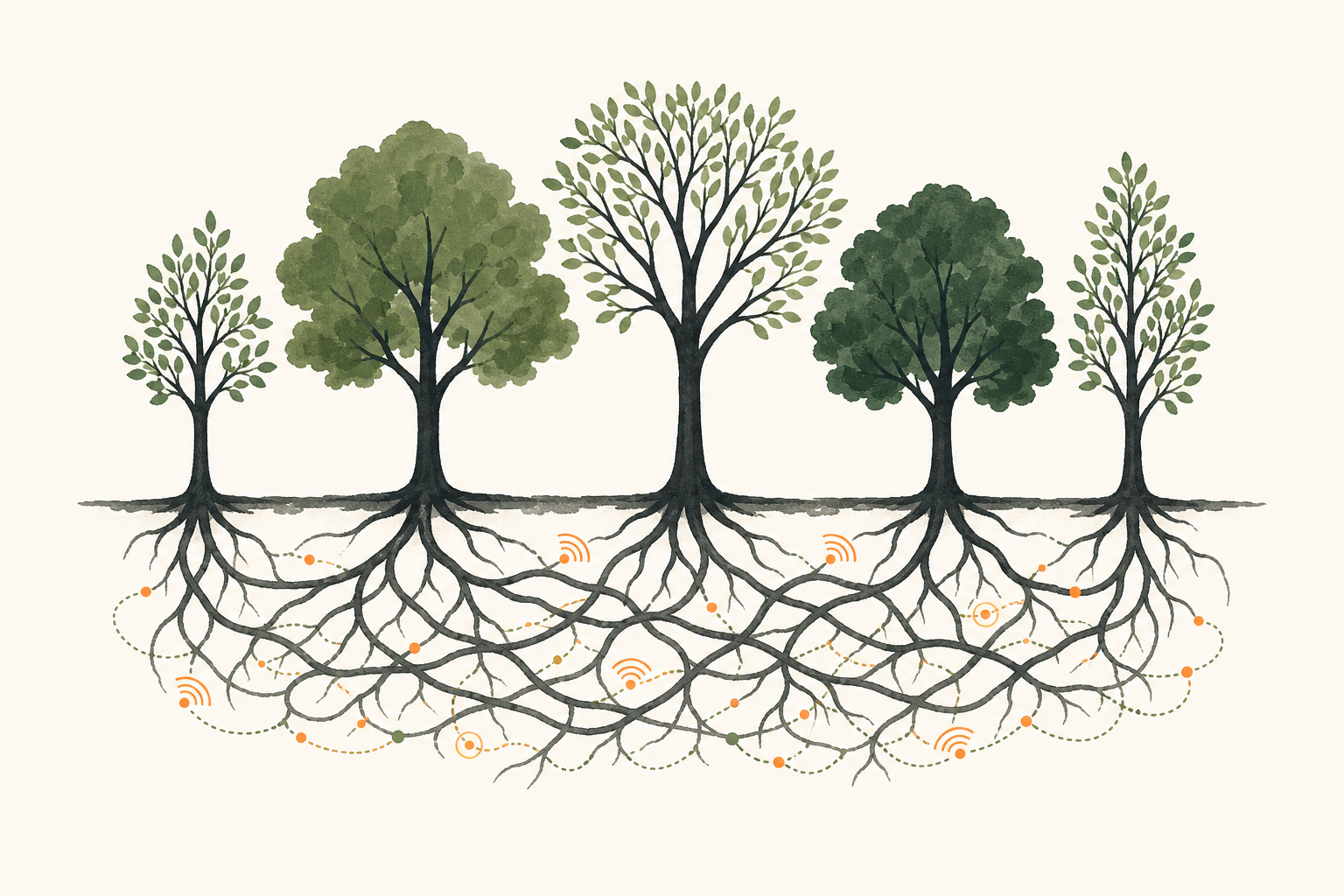
What if one of the biggest limitations in organizational foresight isn’t our ability to anticipate change, but the boundaries we’ve drawn around who gets to observe it?
When we talk about building better foresight, the conversation usually turns to familiar topics. We discuss better horizon scanning, stronger scenarios, more data, or the latest advances in AI. These are all important.
But while working on a recent case study, I found myself returning to a different question. What if the real role of a foresight team is to help people see futures together, rather than simply execute foresight activities?
While studying ETU’s horizon scanning process, one aspect of the case kept drawing my attention. They have developed a mature model of human–AI collaboration, they have a system feeding into decision-making, but the main focus is not in excellence of each step, but the collaboration across the organizations they serve as an industry association.
ETU, the Federation of Finnish Special Commodity Trade, does not conduct foresight only for its own organization. Founded in 1920, ETU represents 14 member associations across 13 industry sectors, serving a specialty retail ecosystem of more than 33,600 companies, with a combined annual turnover of €73.3 billion and around 107,000 full-time employees. Rather than producing foresight solely for itself, ETU develops futures intelligence that supports this wider network of organizations.
That changes the nature of the task. The signals shaping specialty trade do not emerge from one place. They appear in regulation, technology, research, customer behavior, supply networks, crisis management, new business models, and everyday observations from people working across the field. No single team can observe all of this directly.
Yet many foresight processes still rely on a small group of specialists to gather information, interpret it, package the findings, and present them to everyone else. The team may be highly capable, but the design of the system around them might not support or recognize the effort.
Most organizations already have more futures knowledge than they can use
Everyone in an organization notices different changes. We naturally notice different signals depending on our roles and experience.
A salesperson hears a new customer concern before it appears in market research. A regulatory specialist participates in a debate before an early policy shift becomes visible. An engineer keeps track of emerging technologies that do not yet warrant a strategic discussion. A regional team notices behavior that headquarters cannot see.
Partners, suppliers, researchers, startups, industry associations, and customers observe other parts of the same environment. The problem is rarely lack of signals. The harder problem is turning these scattered observations into something that can be examined together and understanding emerging patterns from different points of view.
Without a shared structure, useful insights remain in meeting notes, inboxes, slide decks, spreadsheets, personal bookmarks, and people’s memories. Their connections are easy to miss. Their origins become difficult to trace. When the next foresight project begins, much of the work starts again. Or when you recognize a signal, there is no place to capture it or a library to check whether it relates to something we have spotted earlier. This is one reason foresight can remain dependent on a few individuals even in organizations that genuinely value it. The knowledge exists, but the system does not allow it to accumulate.
Collective foresight requires more than participation
Inviting more people into the process can widen the field of observation. It can also create more noise.
Different contributors use different language. They assess relevance from different positions. Some findings are well supported; others are interesting but feel irrelevant. Similar observations are duplicated because they emerge in different teams. Important minority views may be lost when a dominant interpretation is formed too quickly.
We need more space for foresight discussions, and more places where those discussions can continue over time.
A larger group does not automatically produce better foresight. Collective foresight needs an architecture. It needs clear questions, shared concepts, traceable evidence, and a way to distinguish observations from interpretations, implications and subsequent decisions. It needs processes for reviewing, connecting, challenging, and updating findings. It also needs clarity about who contributes, who validates, who synthesizes, and how the resulting intelligence enters decision-making.
This is where the role of the foresight team begins to change. Here, the team is still responsible for methodological quality and interpretation, but also becomes a steward of the wider system: designing participation, maintaining coherence, preserving alternative perspectives, and connecting futures intelligence to the decisions it is meant to inform.
That is a significantly more demanding role than collecting trends. It is also a more strategic one. It therefore requires leadership support.
What could we learn from the ETU case
ETU’s foresight process combines continuous scanning, human interpretation, AI assistance, and collaboration with a wider stakeholder network. The work moves through recurring phases of scoping, scanning, analysis, and deeper exploration.
Human judgment remains present throughout, while AI supports tasks such as monitoring sources, summarizing findings, translating material, suggesting connections, and accelerating focused research. Data is gathered collectively on the FIBRES platform, and the findings are interpreted together. Implications and next steps are then shaped for each organization willing to take the work further.
As Taija Lintumäki, who leads foresight work at ETU, explains:
“It saves us a lot of time and effort by automating the gathering of relevant insights across themes, something that used to be a manual task.”
The value, however, goes well beyond efficiency. When scanning, interpretation, and dialogue become continuous rather than episodic, foresight starts feeding directly into strategic work instead of remaining a standalone exercise.
Taija describes the impact this way:
“Using FIBRES during our strategic planning opened several ‘aha’ moments for us.”
You do not need every organization to participate in exactly the same way, but they are given the opportunity to contribute to a facilitated process where foresight becomes possible not only for a single organization, but for the future of an entire industry ecosystem.
The centralized foresight platform provides a shared environment where signals, trends, interpretations, and source material can remain connected over time. Selected member organizations can also contribute observations directly instead of sending them into a separate, temporary process. This matters because continuity accumulates the value of foresight.
A signal collected today can remain available when a related development appears six months later. A trend can be revised as evidence changes. Different stakeholder groups can examine the same material from their own perspective.
The public foresight radar can support wider discussion, while the underlying intelligence remains available for deeper analysis. The result is not a single finished picture of the future but a shared capacity to keep observing, learning, and adjusting. Over time, this also builds foresight capability across participating organizations, not just better outputs.
→ Check out ETU's foresight radar on the operating environment of specialty retail (Finnish)
This idea is also shaping our work at FIBRES. We are building for teams that need to combine distributed human knowledge with continuous AI-assisted scanning in one shared foresight process. The aim is to help people maintain a traceable and evolving body of futures intelligence, rather than repeatedly rebuilding it from scattered materials.
The software supports the structure. The real capability develops through the way people use it together.
If you’re curious about what a shared, AI-augmented foresight system could look like in your organization, you’re welcome to book a personal walkthrough of FIBRES with me.
Anna Grabtchak Client Executive at FIBRES, supporting foresight, strategy, and innovation teams in translating insights into actionable outcomes. She is also a doctoral researcher at the Finland Futures Research Center, where her work focuses on foresight maturity and the integration of futures intelligence into organizational strategy.
Stay in the loop
Get our latest foresight tips delivered straight to your inbox. You may unsubscribe from these communications at any time.