
Meet Maija Knutti: Helping organizations make foresight stick
What does it take to make foresight part of how an organization actually works? Our new Customer Success Manager, Maija Knutti, has spent much of her career helping people develop new skills and ways of thinking. Now she’s bringing that experience to FIBRES.
We’re happy to welcome Maija Knutti to the FIBRES team!
Maija joins us from the European Commission’s EU Policy Lab, where she worked on bringing foresight into policymaking and coordinated horizon scanning across EU institutions. Before that, she spent more than a decade in education, leadership, and coaching.
It’s a background that fits her new role rather well. After all, getting the most out of foresight involves more than learning a few methods. It takes practice, collaboration, and finding ways to make foresight useful in everyday work.
I sat down with Maija to hear how she found her way into foresight, why she joined FIBRES, and what she’s looking forward to helping our customers achieve.
From vocational education to strategic foresight
Dani: Welcome to FIBRES, Maija! You’ve had an interesting career, from teaching and education management to foresight at the European Commission. What’s the common thread connecting these different roles?
Maija: Looking back, it’s supporting others to continuously learn and progress.
When I worked as a teacher in vocational education, many of my students were adults changing careers and learning new skills. Later, as an Education Manager, I helped organizations ensure their employees had up-to-date skills and knowledge. And as a leader and working-life coach, I supported individuals and teams in developing their capabilities.
At the European Commission, our task was to bring a more future-oriented culture into policymaking. We supported different policy departments in their foresight work, but a big part of our work was also increasing futures literacy: helping people think more long-term, consider different perspectives, and become more open to change.
I was involved in developing and delivering foresight training for this purpose.
So, my career hasn’t followed a straight path, but helping people and organizations learn has been part of every step.
Dani: What originally sparked your interest in futures thinking?
Maija: It started during my career in education. I was involved in Finland’s Skills Anticipation Forum, which brings together experts to anticipate future skills needs.
But what really awakened my curiosity was a project to design a new campus for a vocational school. We needed to think about what vocational education might look like decades into the future. What skills would people need? What professions might exist? How would people learn?
For example, would we still need a large yard where students could practice driving trucks? Or would future drivers learn through simulations? Would trucks eventually drive themselves? These were very practical questions because we were making decisions about a building that would be used for decades.
That project got me really interested in futures thinking. Later, I had the opportunity to take study leave and complete my Master's Degree in Futures Studies at the Finland Futures Research Centre, University of Turku.
Why FIBRES?
Dani: You’ve been actively involved in the foresight community for years. What made you decide to join FIBRES?
Maija: I’ve been a board member and volunteer at Futures Finland, an association for foresight professionals. Through that network, I already knew some of the foresight experts working at FIBRES, and I’d been following the company’s growth. I knew I’d be working with nice colleagues who are passionate about futures thinking!
I’ve also been following closely how AI is changing foresight work. I want to be part of making that transformation wisely and responsibly. I think dedicated foresight tools, designed and supported by professionals who understand foresight, have an important role to play.
Another thing that attracted me to FIBRES is the focus on collaboration. My previous roles have included a lot of community management, and I’ve learned how important good tools are for supporting cooperation.
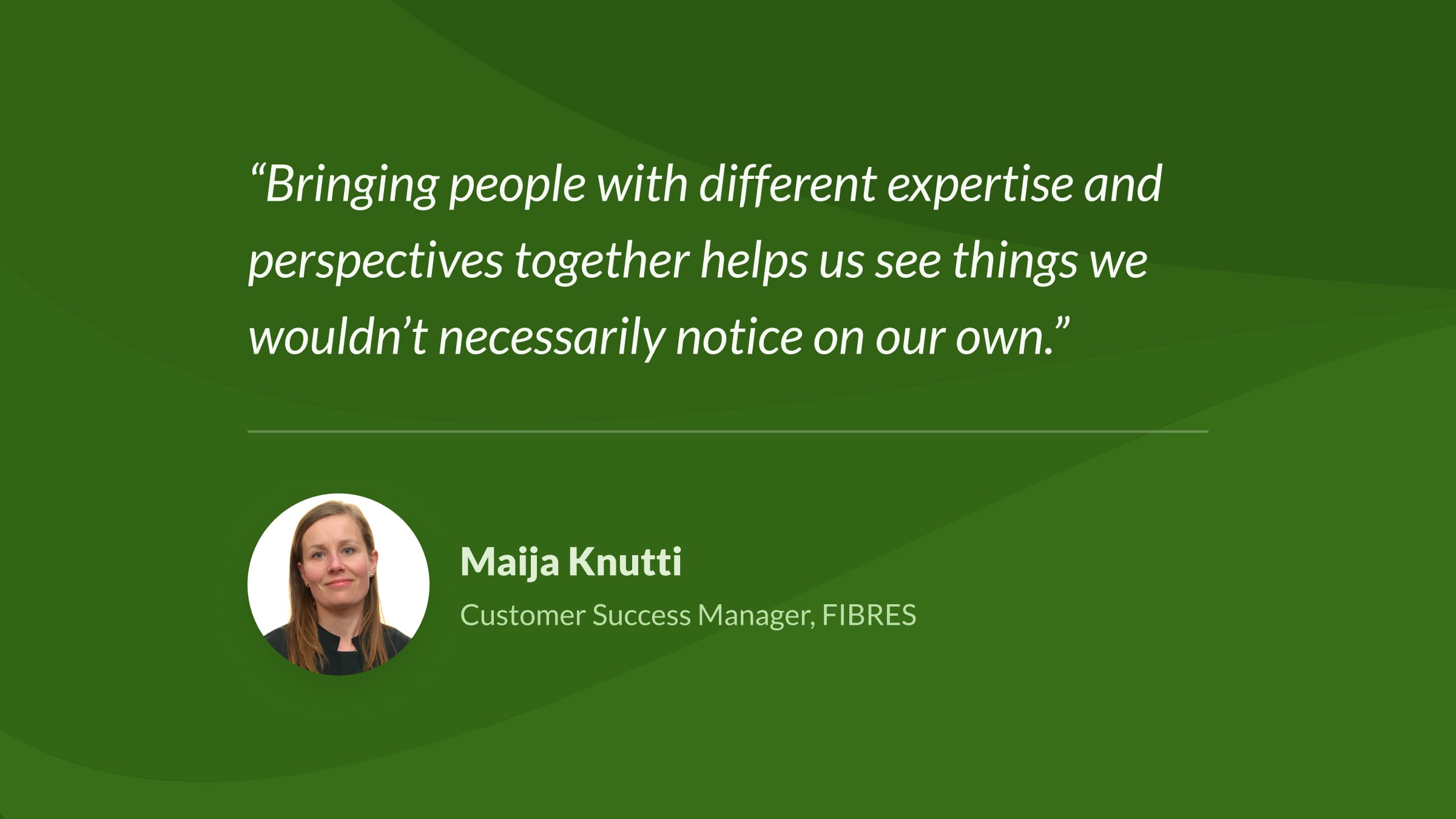
For me, the most valuable part of foresight is collective intelligence. Bringing people with different expertise and perspectives together helps us see things we wouldn’t necessarily notice on our own. A shared platform like FIBRES makes that cooperation much smoother.
Helping customers build a foresight process that works for them
Dani: You’re joining us as a Customer Success Manager, so you’ll be working directly with our customers. When you think about a customer who’s really succeeding with foresight, what does that look like?
Maija: For me, it means they’ve created a smooth foresight process that serves their purpose. They’re producing meaningful results, and those results are actively used. That’s the most important thing.
But there’s another aspect I find particularly interesting: what happens to the people involved. When people start doing continuous horizon scanning and regularly paying attention to signals of change, it can change how they see the world.
It’s like having a new lens. You start noticing things and asking yourself: Is this new? Could this become a trend? What might the future impacts be? People become more aware of change and start considering longer-term possibilities more naturally.
That’s also a sign of success. The organization is developing its foresight capabilities, and the people involved are developing their futures literacy.
Dani: Many organizations have experience with foresight workshops and trend reports, but making foresight part of ongoing decision-making can be difficult. What have you learned about that?
Maija: One important lesson from my work at the European Commission is that foresight needs to be connected to existing decision-making practices. For example, foresight can be part of the impact assessments used when preparing new EU regulations.
It’s important to connect the exploration of possible futures to the present moment. Decisions made today shape the future.
I also strongly believe foresight should be a continuous activity.
At the European Commission, I coordinated the ESPAS interinstitutional horizon-scanning activity. It brought together experts from different fields across EU institutions to continuously reflect on emerging topics and potential future trends that could inform policymaking.
When you’re regularly exposed to signals of change, you develop what I like to call a foresight muscle. You become better at noticing emerging issues and thinking about their possible impacts. That’s why I think continuity is so valuable.
Want to explore this further? Read our guide to horizon scanning and discover how to make tracking signals and trends part of your team’s regular work.
Learning by doing, also in foresight
Dani: You’ve spent much of your career helping people develop new skills. How do you think that experience will help you support FIBRES customers?
Maija: I think my background in teaching will be particularly useful when onboarding new FIBRES users. I’ve studied organizational learning, and throughout my career I’ve supported individuals, teams, and organizations in developing new capabilities. I’m really looking forward to doing that with our customers.
One thing I strongly believe in is learning by doing. I encourage people to try new things quite quickly and lightly. You don’t always need a perfect plan before you begin. By testing and experimenting, you discover what works for you.
I think the same applies to foresight. You can start small, experiment with different approaches, and gradually develop practices that fit your organization’s needs. Having the willingness and courage to experiment is what helps you find your own best practices.
Dani: That sounds familiar! We also want to make it easier for teams to get started with foresight without having to build a complicated process first.
But there’s something else you’ve mentioned that I’d like to explore. You believe futures thinking is something almost anyone can learn. Why is that important to you?
“Foresight is sometimes mystified. But it’s in human nature.”
Maija: I think foresight is sometimes made to sound more mysterious than it needs to be. Futures thinking is actually very natural to us. We’re curious about what might happen, and we constantly make decisions based on our expectations of the future.
But in our professional lives, we’re often so focused on today’s challenges that we don’t make time to think further ahead. And as adults, we sometimes don’t dare to imagine and play.
Imagination is an important part of futures thinking. We need to be able to move beyond linear thinking and consider futures that look quite different from today. That takes practice. It also requires an environment where people feel safe sharing their ideas, opinions, and aspirations.
One concept I find particularly interesting is futures consciousness, which researchers at the Finland Futures Research Centre have studied. It describes our capacity to understand, anticipate, and prepare for the future, including our ability to recognize that we can influence it.
The important thing is that these capacities can be developed. That’s something that really speaks to me because of my background in education and psychology.
Sometimes foresight practitioners are eager to explain what is and isn’t “real foresight.”
I’d rather encourage people to try.
Every attempt to imagine alternative futures helps develop our futures consciousness.
You don’t need to be a foresight expert to start thinking more consciously about the future.
Looking forward to working with FIBRES customers
Dani: I think that’s a great message to end on. Before we wrap up, what are you particularly looking forward to in your new role?
Maija: I’m looking forward to helping customers develop their foresight capabilities in all levels as individuals and teams but also the foresight maturity of the whole organization.
One of the things I enjoy most about foresight is bringing people with different perspectives together to explore possible futures. When people start challenging their assumptions and imagining alternatives together, there can be wonderful aha moments, for example, regarding the plurality of the plausible futures and the agency we can have on shaping them.
I’d love to help more people experience that through their foresight work.
And of course, I’m excited to get to know our customers and learn about the different ways they’re using foresight!
Welcome to FIBRES, Maija!
One thing that stands out to me from our conversation is how naturally Maija connects foresight with learning.
She’s spent years helping people develop new skills, whether in the context of studying for a new profession, supporting career development, adapting to organizational change, or gaining new expertise.
Now she’ll be helping FIBRES customers gain new foresight skills and put them into practice: getting started with the platform, involving colleagues in horizon scanning and trend monitoring, and building foresight processes that support their organization’s decisions.
I’m especially happy that our customers will get to work with someone who combines hands-on foresight experience with such a strong background in teaching and facilitation.
Welcome to the team, Maija!
Want to make foresight easier for your team? FIBRES brings your collaborative and AI-assisted foresight work into one place, helping your team build a continuous process for spotting change and exploring what it means for your organization.

Dani Pärnänen The Chief Product Officer at FIBRES. With a background in software business and engineering and a talent for UX, Dani crafts cool tools for corporate futurists and trend scouts. He's all about asking the right questions to understand needs and deliver user-friendly solutions, ensuring FIBRES' customers always have the best experience.
Stay in the loop
Get our latest foresight tips delivered straight to your inbox. You may unsubscribe from these communications at any time.