Teaching design futures: How Aalborg University turns weak signals into real-world design ideas
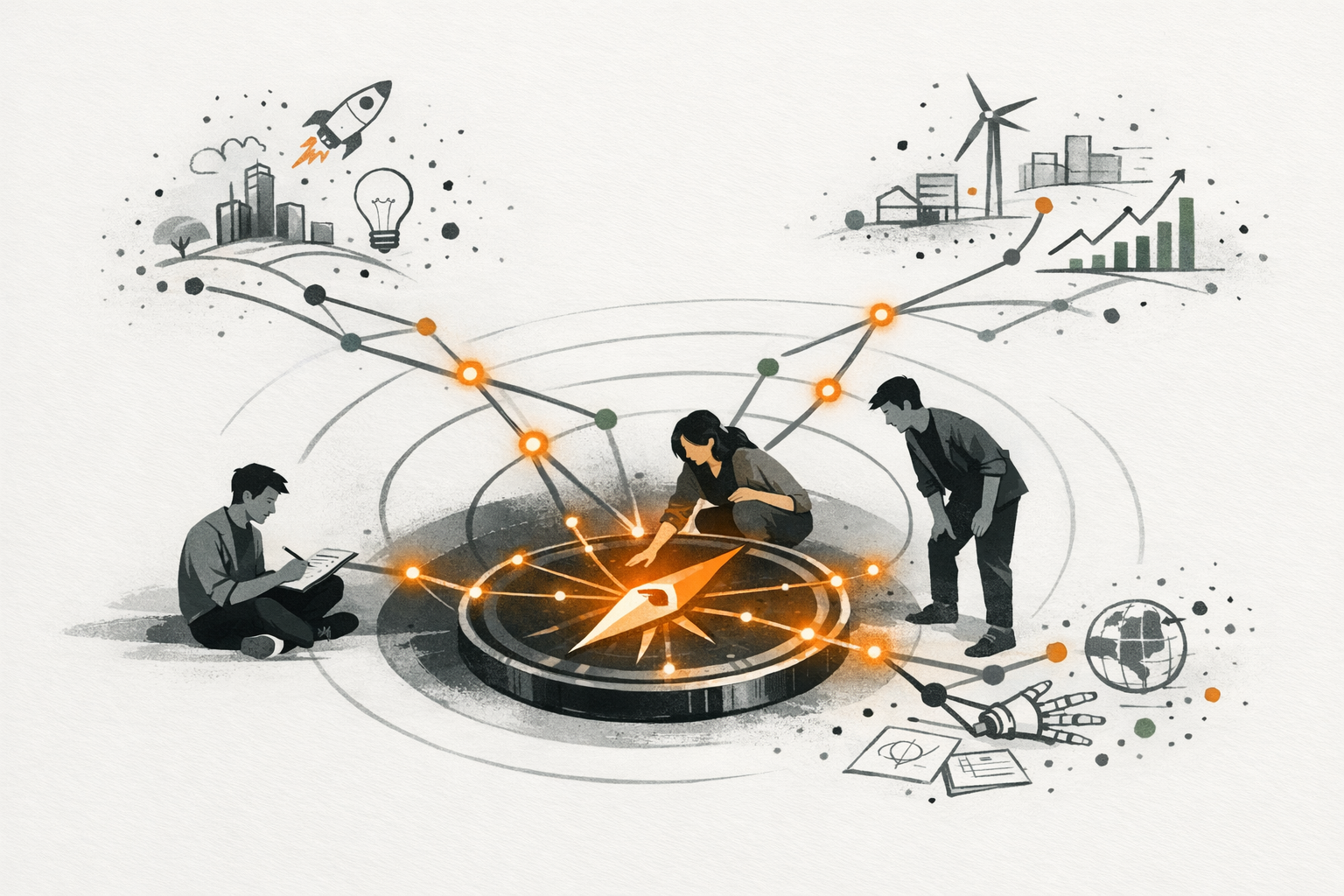
“Students who can’t reason about futures are effectively designing for a world that no longer exists.”
That is how Luca Simeone, Associate Professor at Aalborg University, describes the importance of foresight in design education today.
At Aalborg University, futures thinking is taught as a practical capability. Students learn to work with uncertainty, make sense of incomplete information, and turn early signs of change into ideas that can support real strategic conversations.
In the Design Futures module within the MSc Service Systems Design program, students explore the intersection of futures studies and design practice. The course covers speculative design, design fiction, and experiential futures, while grounding these methods in real organizational challenges.
Luca’s own work spans design, innovation, strategy, AI-powered data science, and futures thinking. He works as both a scholar and a practitioner: the methods he develops in research are tested through founding companies, consulting internationally, and deploying real products and services. His recent book Futures Thinking: Using a Multidisciplinary Approach (Routledge, 2026) is one example of this two-way exchange between theory and practice.
Why foresight belongs in design education
Service designers increasingly work on systems that will operate in uncertain, fast-changing environments.
Customer expectations shift. Technologies mature unevenly. Regulations change. Business models evolve. Social and ecological pressures reshape what people need from services. Designing only for the present can easily produce concepts that feel polished today and outdated tomorrow.
For Luca, this makes foresight an essential capability for students.
Designers need to understand how different futures could emerge, how forces of change interact, and how today’s design choices may create consequences later. They need ways to explore uncertainty without getting lost in speculation.
In the Design Futures course, students practice moving from early observations to more structured interpretations. They examine signals of change, identify emerging patterns, and connect those patterns to design opportunities.
The aim is to help students become more confident working with futures as part of design practice.
Real briefs make foresight real
Aalborg University is known for problem-based learning. In practice, this means students do not only study theories and methods. They apply them to real challenges.
In the Design Futures module, student groups work with industry-facing briefs. In recent years, this has included cases connected to IKEA and the future of loyalty programs, where students have explored how loyalty, customer relationships, and value creation could change over time.
This practical setting is central to the learning experience.
“Theory without application produces fragile competence,” Luca says.
Real briefs expose students to the kind of complexity that cannot be simulated neatly in a textbook. The data is incomplete. The brief is open-ended. Stakeholders may care about different things. The final output needs to be clear enough to be useful for an organization, not just interesting from an academic point of view.
That friction is where students develop stronger foresight skills.
They need to work through questions such as:
- What weak signals suggest that change is already happening?
- Which signals connect into broader emerging trends?
- What could these trends mean for the organization?
- Which implications should decision-makers pay attention to?
- How can those implications inform future-facing design ideas?
By working with real briefs, students learn that foresight needs structure, judgment, creativity, and discipline. They also learn that a good futures project should eventually help someone think, decide, or act differently.
The challenge: information overload without structure
Before using FIBRES, one of the main challenges students faced was not a lack of information. It was too much information, spread across too many places.
Students could find articles, cases, examples, reports, observations, and inspiration. But turning that material into a coherent foresight process was harder. Signal collections grew quickly. Connections were easy to miss. Different groups used different formats. Shared documents and slide decks created versioning issues. The emerging trend landscape was difficult to keep visible.
Luca describes the core problem simply: “Information overload without structure.”
Students often produced large, unorganized signal sets with no clear method for clustering findings or connecting them to strategic implications. This made it harder to move from research to interpretation, and from interpretation to recommendations.
The same challenge is familiar inside organizations. Foresight teams rarely struggle because they lack material. They struggle because inputs are scattered, ownership is unclear, and the path from observation to implication is difficult to maintain across people, projects, and time.
A signal may be useful on its own. A group of related signals may reveal an emerging trend. A trend may carry implications for strategy, innovation, risk, or design. If those relationships are not visible, the work can easily become a collection of interesting fragments.
That is especially difficult in a course where students need to learn both the method and the mindset.
From horizon scanning to trend radars
In the course, students use FIBRES as part of their practical foresight workflow.
They begin with horizon scanning, looking for weak signals relevant to the brief. These signals may include emerging customer behaviors, new business experiments, technology developments, cultural shifts, policy changes, or examples from adjacent industries.
Students then collect and tag their findings in a shared workspace. As the project develops, they cluster related signals into emerging trends and start building a clearer picture of the trend landscape around their topic.
For industry-facing projects, this structure helps students move from scattered observations to more strategic outputs. They can create trend radars, discuss the relevance of different themes, and connect their findings to design opportunities.
In Luca’s course, the final delivery is always connected to a design idea or solution. Students need to translate what they have found into something that can help an organization think differently about the future.
FIBRES helps students hold the thread across the process: from scanning signals, to clustering trends, to building radars, to shaping strategic implications and recommendations.
This matters in a learning environment because it makes the foresight process tangible. Students can see how individual signals connect to larger patterns, and how those patterns can inform a design direction.
What changed after introducing FIBRES
After introducing FIBRES into the course, Luca noticed a clear improvement in the coherence and quality of student work.
“Final outputs became noticeably more coherent and evidence-backed,” he says.
The platform helped reduce the time students spent managing information. Instead of wrestling with scattered files, duplicated links, version conflicts, and unstructured notes, student groups could work in a shared environment designed for foresight.
That improved more than efficiency. It improved the thinking.
According to Luca, the platform’s built-in logic nudged students toward more disciplined foresight reasoning without requiring constant instructor intervention. The workflow itself helped students understand the movement from signals to trends, from trends to implications, and from implications to recommendations.
This freed up cognitive bandwidth for the parts of the work where students add the most value:
- Making sense of patterns
- Discussing strategic relevance
- Connecting trends to design opportunities
- Iterating concepts
- Building clearer evidence behind final recommendations
- Preparing outputs that industry partners can understand and use
The result was a smoother path from early research to final design ideas.
Making foresight tangible
One of the most interesting changes was how quickly students began to understand foresight as a way of working.
“What surprised me most is how quickly students internalize foresight as a genuine mode of inquiry once the process becomes tangible rather than abstract,” Luca says. That shift is important.
For many students, foresight can first appear broad or difficult to grasp. Concepts such as weak signals, trends, scenarios, and strategic implications make more sense once students work through them in a real project. A tangible workflow helps students see what each step contributes.
They learn that collecting signals is only the beginning. They need to ask why a signal matters, what it connects to, what larger change it may point toward, and what it could mean for a specific organization or design challenge.
This makes foresight easier to learn and easier to apply.
It also gives students a professional habit they can take with them into organizations where future-oriented thinking is becoming more valuable, but still often lacks structure.
Why purpose-built foresight tools matter in education
Many students and professional teams still manage foresight work with spreadsheets, documents, slides, and generic collaboration tools. Those tools can be useful, but they also shape the work.
“Spreadsheets impose a document logic on what is fundamentally a relational, iterative process,” Luca says.
Foresight depends on relationships. Signals connect to other signals. Trends develop over time. Implications shift as new evidence appears. Different people may interpret the same material differently. The work needs room for iteration, discussion, and synthesis.
A purpose-built foresight platform supports that logic more directly.
As Luca explains, “A purpose-built platform embeds the epistemology of foresight, signals lead to trends, trends carry implications, implications inform strategy, directly into the workflow.”
For students, this has two benefits:
First, the workflow reinforces the method. Students learn foresight by doing it in a structure that reflects the logic of the field.
Second, they gain experience with professional tooling. That matters because many organizations are still figuring out how to move from scattered trend work to more systematic futures intelligence.
“Students graduate with both the method and the professional tooling,” Luca says. “This gives a competitive advantage to our alumni while approaching external organizations.”
What organizations can learn from Aalborg University’s approach
The lessons from Luca’s courses reach well beyond the classroom. The challenges students face in a design futures course are close to the challenges many foresight, strategy, innovation, risk, and R&D teams face inside organizations.
There is too much information. The signals are scattered. The trend landscape changes quickly. Collaboration happens across different people and perspectives. Leaders need outputs that are clear, evidence-backed, and connected to action.
Aalborg University’s approach offers a few practical reminders:
- Start with real questions, not generic trend lists.
- Give people a shared structure for collecting and interpreting signals.
- Keep evidence, trends, and implications connected.
- Make collaboration visible from the beginning.
- Treat foresight as a living workflow, not a one-time report.
- Use tools that support sensemaking, not just storage.
For organizations, this is where foresight becomes more useful. The work becomes easier to trust when people can see the evidence behind an insight. It becomes easier to discuss when trends are visualized clearly. It becomes easier to act on when implications are connected to real strategic or design choices.
Building future-ready skills through applied foresight
The Design Futures course sits at a valuable intersection: academic foresight, design practice, and real-world strategic innovation.
Students learn to work with uncertainty in a structured way. They practice scanning for signals, clustering emerging trends, building trend radars, and translating findings into future-facing design ideas. They also learn how to explain their reasoning to people outside the classroom.
That combination is increasingly important.
Organizations need people who can notice change early, make sense of weak signals, and turn uncertainty into better questions, stronger concepts, and more resilient strategies.
For students, working with real briefs gives these skills practical weight. They leave the course with experience from the messy middle of foresight: the scanning, sorting, connecting, interpreting, and translating required to make futures thinking useful.
For Aalborg University, FIBRES helps make that process more visible and manageable. It gives students a shared place to build their foresight work and a clearer path from research to recommendations.
And for the students themselves, it helps turn foresight from an abstract topic into a capability they can use.
Explore applied foresight with FIBRES
FIBRES helps teams and educators move from scattered signals to structured, evidence-backed foresight.
With collaborative workspaces, horizon scanning, weak signal collection, trend radars, and structured foresight workflows, FIBRES supports practical futures work from early research to strategic recommendations.
If your team is trying to build a clearer path from signals to trends, and from trends to action, FIBRES can help you create the workflow around it. Explore the platform or book a demo to see how signals, trends, radars, and recommendations connect in one shared workspace.

Dani Pärnänen The Chief Product Officer at FIBRES. With a background in software business and engineering and a talent for UX, Dani crafts cool tools for corporate futurists and trend scouts. He's all about asking the right questions to understand needs and deliver user-friendly solutions, ensuring FIBRES' customers always have the best experience.
Stay in the loop
Get our latest foresight tips delivered straight to your inbox. You may unsubscribe from these communications at any time.