Most organizations pay close attention to what is already visible. They follow established trends, benchmark competitors, and track developments that have already entered mainstream discussion. Yet many of the changes that later reshape industries begin somewhere else.
“The genuinely new always starts from the margins,” says Professor Markku Wilenius. “It doesn’t come from the center.”
That observation sits at the heart of how Wilenius teaches strategic foresight at the Turku School of Economics at the University of Turku, one of the world’s longest-running academic institutions dedicated to futures studies.
For more than three decades, Wilenius has worked at the intersection of futures research, business strategy, innovation, sustainability, and education. During that time, he has seen strategic foresight evolve from a niche practice into a capability increasingly used by companies trying to navigate uncertainty, technological change, and shifting competitive landscapes.
His students learn foresight methods, horizon scanning, scenario planning, trend analysis, and futures thinking as a whole. They also learn something less discussed but equally important: how to challenge their own assumptions.
From global futures to strategic foresight
Wilenius’ own path into futures studies began in the early 1990s. At the time, he was researching global environmental problems and interviewed Pentti Malaska, founder of the Finland Futures Research Centre and one of Finland’s most influential futures thinkers. Malaska had been involved with the Club of Rome since the 1970s and spent much of his career examining long-term global development.
The meeting left a lasting impression.
“When I came out of that meeting, I was completely certain that my future would be something to do with future studies.”
A few years later, Wilenius joined the Finland Futures Research Centre and soon became its director. The timing coincided with Finland’s entry into the European Union and the rapid expansion of European research and innovation programs.
The centre grew through international collaboration, research projects, and educational initiatives. Wilenius later became Finland’s first Professor of Future Studies.
Today, the centre brings together researchers, educators, doctoral candidates, and practitioners working across topics ranging from technology and innovation to sustainability and societal change.
Why strategic foresight cannot rely on a single future
When Wilenius began introducing strategic foresight into company settings, many organizations had little familiarity with the field. Before any meaningful work could begin, teams needed to understand what foresight was, why it mattered, and how it differed from conventional planning.
The biggest shift was conceptual.
Most organizations were accustomed to discussing one expected future. Strategic foresight required them to consider several possible futures and to examine the forces shaping their operating environment.
“One future approach is not sufficient for today’s world in this level of complexity and uncertainty.”
For Wilenius, strategic foresight starts by widening the discussion.
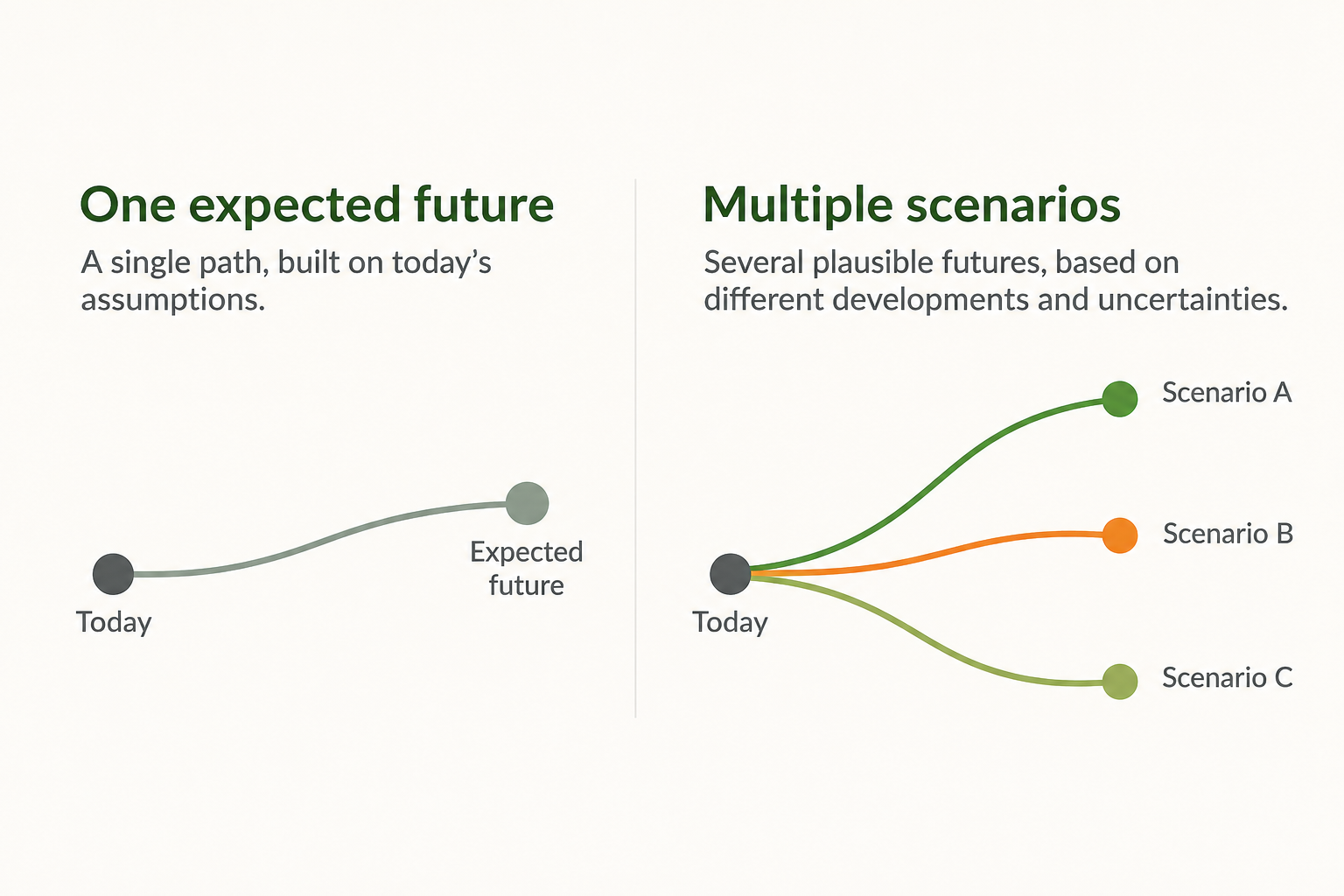
Organizations need methods that help them explore alternative developments, identify critical uncertainties, and understand how broader changes may affect their choices. Those conversations become more valuable when people have a stake in them.
“Commitment comes through engagement.”
That principle shapes both his teaching and his work with organizations. People participate more seriously when they understand how future developments connect to their own work, decisions, and responsibilities.
Why students work on real organizational challenges
Every year, students in Wilenius’ Strategic Foresight course work on real cases provided by companies and organizations. The reason is straightforward: a practical assignment changes how students approach the work.
Instead of studying foresight methods in isolation, they apply them to actual challenges, opportunities, and decisions. They experience the ambiguity that organizations face when they try to make sense of change.
Wilenius has found that this produces a different kind of engagement.
Students begin to understand what it means to support strategic decision-making inside an organization. They learn how to frame questions, gather evidence, evaluate competing interpretations, and communicate insights that others can use.
“The future is an act. It’s not a passive state.”
That perspective runs through the entire course.
Foresight is not treated as prediction. Students are expected to examine alternatives, develop scenarios, and think through the consequences of different developments. The emphasis is on decision-making and action, not forecasting accuracy.
Testing assumptions, not just exploring futures
One recurring lesson in the course concerns organizational beliefs: Companies often have strong assumptions about their customers, capabilities, markets, or competitive position. Some assumptions remain valid. Others survive long after the conditions that created them have changed.
Wilenius has seen this repeatedly in business environments.
A company may still believe it has a leading position in a market because that was true five or ten years ago. The belief becomes part of organizational culture and continues to shape decisions even when reality has shifted.
“Sometimes it might be just the old folklore.”
This is why foresight work cannot focus exclusively on future developments. It also requires a close examination of the present.
Students are encouraged to look beyond surface-level assessments and ask deeper questions about the assumptions that guide organizational thinking. Scenario planning, critical uncertainties, horizon scanning, and other foresight methods help expose areas where current beliefs deserve closer scrutiny.
For Wilenius, understanding the present is inseparable from understanding the future.
Why horizon scanning matters
The strongest theme in Wilenius’ approach to foresight concerns novelty. History offers a consistent pattern.
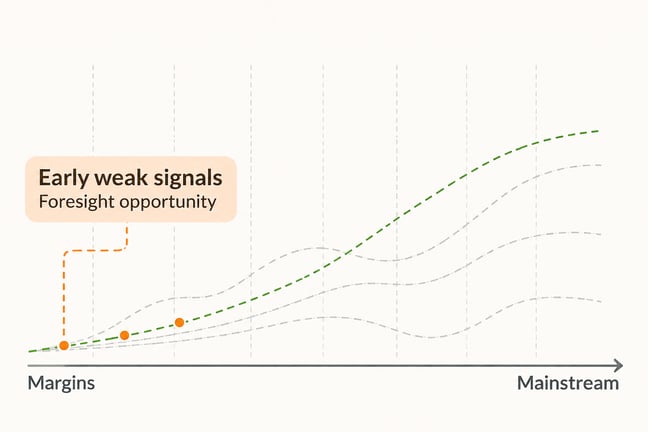
New technologies, social innovations, business models, and cultural shifts rarely emerge from the center of established systems. They appear first at the edges, where they are easy to dismiss or overlook.
“The genuinely new always starts from the margins.”
What later appears sudden usually has a long history. The signals were visible, but few people paid attention to them.
Explore how horizon scanning with FIBRES helps teams identify, collect, and monitor emerging signals.
Organizations often focus their attention on dominant trends because those developments feel more relevant and easier to justify. Yet the developments with the greatest long-term significance frequently begin as weak signals.
This is where horizon scanning becomes valuable.
“The real pearls very often come from those margins.”
Weak signal scanning helps organizations look beyond the developments everyone already sees. It expands the search space. It increases the chance of identifying changes before they become widely recognized.
“The challenge of foresight is to find genuinely weak signals before they become strong signals.”
For companies competing in increasingly global markets, that capability matters. Competitive advantage rarely comes from noticing the same developments at the same time as everyone else.
Teaching collaborative foresight with FIBRES
Digital tools have changed how foresight work is conducted. According to Wilenius, the difference compared to ten years ago is substantial. Researchers and practitioners now have access to tools that make it easier to find information, organize observations, connect related developments, and work collaboratively.
For the Strategic Foresight course, this has practical implications. Students already arrive with a foundation in foresight theories and methods. The next challenge is learning how to apply those methods in a structured and collaborative environment.
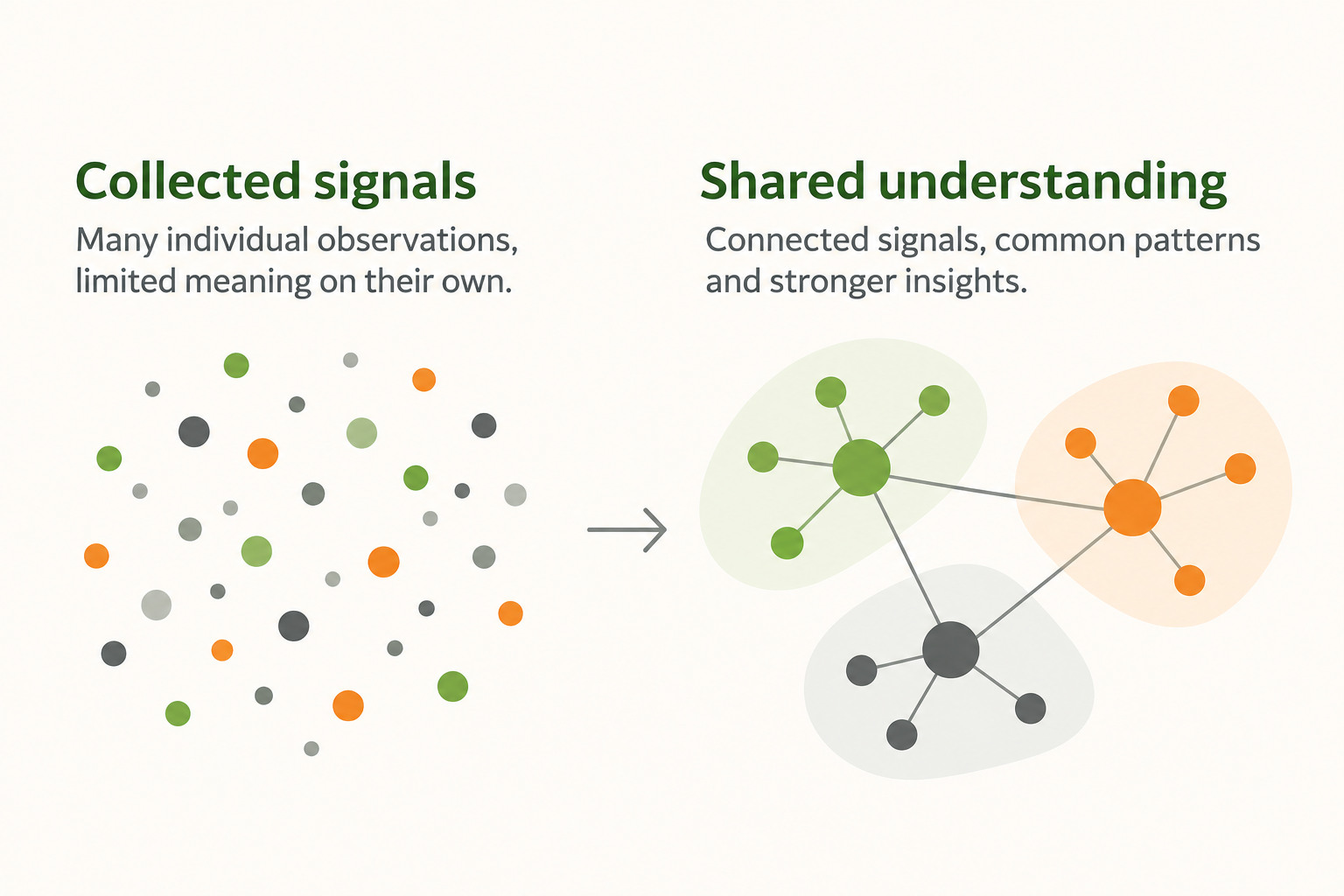
This is where FIBRES plays a role. Wilenius has used FIBRES in the course for three consecutive years. Students use the platform to collect signals, organize findings, compare interpretations, discuss emerging developments, and build a shared evidence base for their projects.
What he values most is not the collection of information itself. It is the discussion that follows.
That shared workspace allows students to move beyond individual observations. They can examine why particular signals matter, connect related developments, challenge each other’s interpretations, and build collective understanding around the evidence they gather.
From a pedagogical perspective, this matters because strategic foresight is rarely an individual activity.
Organizations need ways to combine different perspectives, document their reasoning, and create transparency around how conclusions are reached.
Wilenius sees this as one of the platform’s strongest contributions to the course. After three years of use, his assessment is simple: “It has become an indispensable part of the course.”
Exploring foresight platforms? Book a personal walkthrough of FIBRES to find out why it is the platform of choice for many organizations that need to make future-oriented decisions.
Preparing students for professional foresight work
Students encounter a range of foresight tools during their studies. The objective is not to teach software. It is to expose students to the environments and workflows they are likely to encounter in professional practice.
Foresight practitioners today work with large volumes of information. They monitor signals, analyze trends, build scenarios, collaborate across disciplines, and communicate findings to decision-makers.
Learning those skills requires more than reading about methods. Students need opportunities to apply them.
Platforms such as FIBRES help bridge that gap by giving students practical experience with collaborative horizon scanning, futures intelligence, signal analysis, and shared sensemaking.
For Wilenius, that practical dimension is one of the reasons real-world projects remain central to the course. The goal is to teach futures studies while also helping students learn how foresight is actually practiced.
Looking beyond the obvious
Many organizations become highly effective at monitoring developments that are already visible. Strategic foresight asks them to look elsewhere as well.
The signals at the margins are usually incomplete. They are easy to ignore. They rarely arrive with clear evidence that they will matter.
That is precisely why they deserve attention.
For Wilenius, one of the most important capabilities students can develop is the ability to notice those early signals, examine them critically, and explore what they might mean before they become obvious.
The future does not arrive all at once. More often, it begins at the edges.