Foresight is becoming a team sport between companies, not just inside them
In recent roundtable discussions we hosted in Paris, we asked two simple questions: When did your organization get the future wrong, and when did you see change early enough to act?
Simple questions, yes. Comfortable questions, not always.
But they led to exactly the kind of discussion I like most: practical, honest, and slightly uncomfortable in a useful way.
We talked about decision-making under high uncertainty. We talked about AI, innovation, future scenarios, trend radars, and the changing role of foresight teams. We heard examples from companies that have clearly invested serious time and effort into building mature strategic foresight and innovation intelligence capabilities.
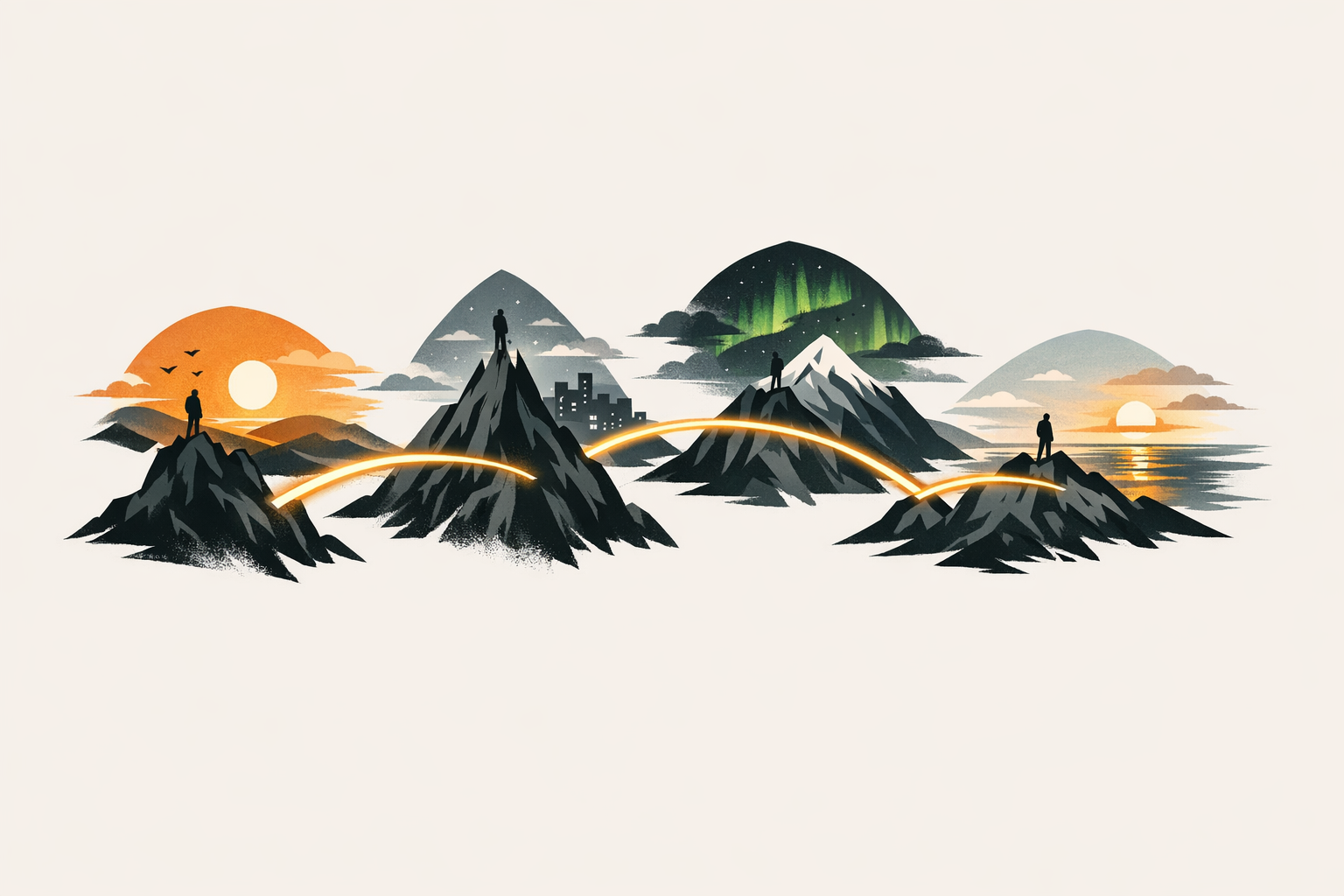
But one thought stayed with me after the event: Many of the biggest future challenges companies are trying to understand today no longer fit inside one company’s walls.
Climate transition. Energy systems. Regulation. Artificial intelligence. Supply chains. Consumer behavior. Technology disruption. These forces move across industries, partners, customers, suppliers, regulators, and societies.
So here is the question I have been thinking about since Paris: If the future is increasingly shaped across ecosystems, why is foresight still so often practiced as an internal activity?
Foresight has grown up inside organizations
For a long time, the development path of corporate foresight has been quite clear:
-
You build awareness.
-
You start collecting signals.
-
You create trend reports, scenarios, radars, and workshops.
Then, if things go well, you connect foresight to strategy, innovation, R&D, risk, and decision-making.
Many mature organizations are now somewhere in this later phase. They are no longer asking whether foresight is useful. They are asking how to make it continuous, scalable, and connected to real decisions. That is good progress.
At the same time, it also reveals the next limitation: Even a very good internal foresight setup can only see part of the system. Your teams see what your teams are exposed to. Your sources reflect your assumptions. Your experts interpret change through your company’s strategy, culture, and incentives.
That is not a criticism. It is simply how organizations work. But when the forces shaping your future are ecosystem-level forces, an internal view is rarely enough.
The companies furthest ahead are already sensing this shift
During the Paris event, several discussions pointed in this direction.
A major pharmaceutical company presented their thinking around advanced foresight setups, including how data, AI, and internal knowledge can be brought together more systematically. What I found especially interesting was the idea that foresight should also happen in company networks, not only inside one company. That is a very important shift.
An industrial conglomerate in their presentation raised another highly practical point: trustworthy data sources are key. In a world where AI can generate summaries at impressive speed, source quality and traceability are crucially important.
There was also a good discussion around how foresight roles are changing. Experts are no longer only expected to submit signals or write trend descriptions. Increasingly, they may become source curators, AI workflow designers, model validators, and sensemaking partners.
That is a big change in the daily work of foresight.
And in a few more private discussions, I heard about increasing ambitions for cross-company foresight as part of open innovation. Again, the same pattern appeared: future intelligence is becoming something organizations may need to build with others.
When you hear similar ideas from different directions, it is worth paying attention to.
Why internal intelligence alone starts to fall short
Let’s take a concrete example.
Imagine you are trying to understand the future of energy transition.
You can scan policy documents, technology news, academic research, startups, patent activity, investment signals, and customer behavior. You can build a very good internal trend radar. You can even use AI horizon scanning to monitor signals continuously.
All certainly useful.
But the actual future will also depend on grid operators, regulators, industrial customers, infrastructure providers, technology vendors, city planners, investors, consumers, and political decisions.
No single company has the full picture.
The same applies in many other areas - a lot of well-aligned activity or even collaboration across multiple parties is required:
-
In healthcare, change depends on between regulators, payers, patients, providers, technology companies, and public trust.
-
In consumer goods, emerging behavior is shaped by retailers, platforms, supply chains, culture, sustainability expectations, and purchasing power.
-
In mobility, no company can understand the future without looking at cities, energy systems, policy, data, infrastructure, and consumer habits.
-
In AI, future risks and opportunities emerge through a messy combination of technology, regulation, talent, ethics, business models, and social acceptance.
This is why collaborative foresight becomes interesting.
Nobody is saying companies should share everything. Of course they should not. But many future questions become more useful when explored together.
From company foresight to ecosystem foresight
I think we are starting to see the early shape of what could become ecosystem foresight.
By ecosystem foresight, I mean structured futures intelligence work across organizational boundaries. That could include shared horizon scanning, joint weak signal detection, collaborative trend monitoring, shared future scenarios, or industry-level trend radars.
In practice, it might look like this:
-
Several companies monitor a common set of change drivers.
-
Experts from different organizations contribute signals from their own vantage points.
-
AI helps cluster, summarize, and connect findings across a large intelligence base.
-
Human experts review, challenge, and interpret what the signals might mean.
-
Shared trend radars help create a common language for emerging change.
-
Each organization uses the shared intelligence to continue deeper with its own strategy, innovation, R&D, or risk work.
This is not science fiction. Pieces of this are already happening.
We are also exploring related questions through the FORECO project, which looks at foresight in ecosystems. What makes that work especially interesting to me is that it focuses on the less glamorous but absolutely critical parts of collaboration: governance, trust, data ownership, incentives, and practical ways of working.
Because let’s be honest, the hard part is rarely making people agree that collaboration sounds nice.
The hard part is making it work on the practical level, every day.
AI makes this more urgent, not less
AI is changing strategic foresight very quickly.
It can help scan sources, detect weak signals, summarize large volumes of material, draft trend descriptions, support clustering, and create first versions of trend radars.
This is already changing the economics of foresight work.
A small team can now process far more information than before. Manual scanning becomes less painful. Trend monitoring becomes more continuous. AI-assisted reporting can reduce hours of formatting and first-draft writing.
Wonderful. But then comes the next problem.
When everybody can scan more, summarize more, and generate more, what becomes valuable? I would argue it is the quality of interpretation:
The quality of the sources.
The quality of the questions.
The quality of the shared understanding.
And, increasingly, the quality of the network contributing to that understanding.
AI can help you collect and structure signals. But deciding what matters, why it matters, and what should be done about it still requires human judgment.
Often, that judgment becomes better when different organizations compare what they are seeing.
What collaborative foresight needs in practice
If you want foresight to work across companies, you need more than good intentions and a few enthusiastic workshops.
You need a practical operating model.
At minimum, collaborative foresight needs:
-
A shared purpose: What future questions are worth exploring together?
-
Clear boundaries: What can be shared, and what must remain internal? How is data ownership agreed upon?
-
Trusted sources: Which data, publications, experts, and signals are reliable enough to use?
-
Common language: How do participants define signals, trends, uncertainties, drivers, and implications?
-
Traceability: Can insights be linked back to evidence?
-
Structured sensemaking: How are signals assessed, clustered, and turned into strategic meaning?
-
Living outputs: How do radars, scenarios, and trend libraries stay updated over time?
-
Decision connection: Where does the intelligence actually influence strategy, innovation, risk, or R&D?
Without these, collaborative foresight easily becomes just another discussion forum.
Interesting, perhaps. Useful, occasionally. Strategically valuable, not reliably.
The organizations that get this right will treat collaborative foresight as an intelligence system, not as an event.
Shared intelligence needs shared infrastructure
This is where the tooling question becomes very practical.
If collaborative foresight depends on shared signal collection, AI-assisted analysis, trend monitoring, radar building, source traceability, and stakeholder collaboration, then email threads and static slide decks will not carry the load for very long.
They are fine for communication, but very poor at building an accumulated knowledge base.
A living foresight system needs to preserve the connection between signals, trends, interpretations, and decisions. It needs to allow different people to contribute without turning the whole thing into chaos. It needs to make AI useful without making the process feel like a black box.
This is naturally close to what we work on at FIBRES: horizon scanning, signal collection, collaborative trend radars, AI-assisted clustering, shared workspaces, and traceable futures intelligence.
But the larger point is that foresight is becoming operational regardless of the platform. If it becomes operational inside companies, it will also need to become operational between companies. That requires structure.
What this means for foresight professionals
I find this shift exciting because it raises the importance of foresight professionals rather than reducing it.
If AI takes over the more mechanical scanning and drafting work, foresight experts can spend more time on the parts where they create the most value:
-
Framing better questions.
-
Curating better sources.
-
Designing better sensemaking processes.
-
Connecting people who see different parts of the future.
-
Helping leadership understand what signals mean for decisions.
In an ecosystem setting, the foresight professional may become something like an intelligence architect. A facilitator of shared understanding. A translator between signals and strategy. A builder of trust between organizations.
That is a much more strategic role than being the person who updates the trend deck once a quarter. No offence to trend decks. Some of my best friends are trend decks 😉
What leaders should start asking
If you are responsible for strategy, innovation, foresight, R&D, or risk, you do not need to solve ecosystem foresight all at once.
Start with better questions. For example:
-
Which major uncertainties affecting us are also affecting our partners, customers, suppliers, or industry peers?
-
Where are we relying too much on internal assumptions?
-
Which weak signals are we likely to miss because they appear outside our normal field of vision?
-
Over which future time frames do we have the best view, and which time frames some of our ecosystem partners might have a better understanding of?
-
Where would shared horizon scanning create better strategic awareness?
-
Which future risks require ecosystem-level preparation?
-
Which opportunity spaces would benefit from open innovation and shared foresight?
-
What intelligence could we safely build together without compromising competitive advantage?
These questions are practical. They also make foresight more relevant to real decisions, because the purpose of foresight is not to admire interesting trends but rather to improve the quality of decisions under uncertainty.
The next maturity step may be outside your walls
I have often said that foresight only becomes valuable when it has an impact on decisions taken. Inside a company, this means discussing and connecting with people across functions: strategy, innovation, risk, R&D, marketing, sales, technology, sustainability, leadership, you name it.
But perhaps the next maturity step is learning how to extend those conversations beyond the company? Carefully, selectively, with the right partners and with clear governance. Shared tools and trusted ways of working will definitely help getting there.
This will not be easy. And it will not replace internal foresight work. You still need your own point of view, your own strategic logic, and your own decisions. But if your future is shaped by an ecosystem, your foresight should probably learn to listen to that ecosystem.
The organizations that figure this out early may gain something very valuable: not just more information, but better shared understanding. And in uncertain times, shared understanding is a surprisingly powerful advantage.
If you'd want to figure all of this out together with us, you're welcome to book a meeting with me or one of our foresight and platform experts.

Panu Kause is the founder and CEO at FIBRES. Before founding FIBRES, he held several management positions and ran his own foresight and strategy focused consultancy.
Stay in the loop
Get our latest foresight tips delivered straight to your inbox. You may unsubscribe from these communications at any time.