
From slides to a shared workspace: when foresight breaks at scale
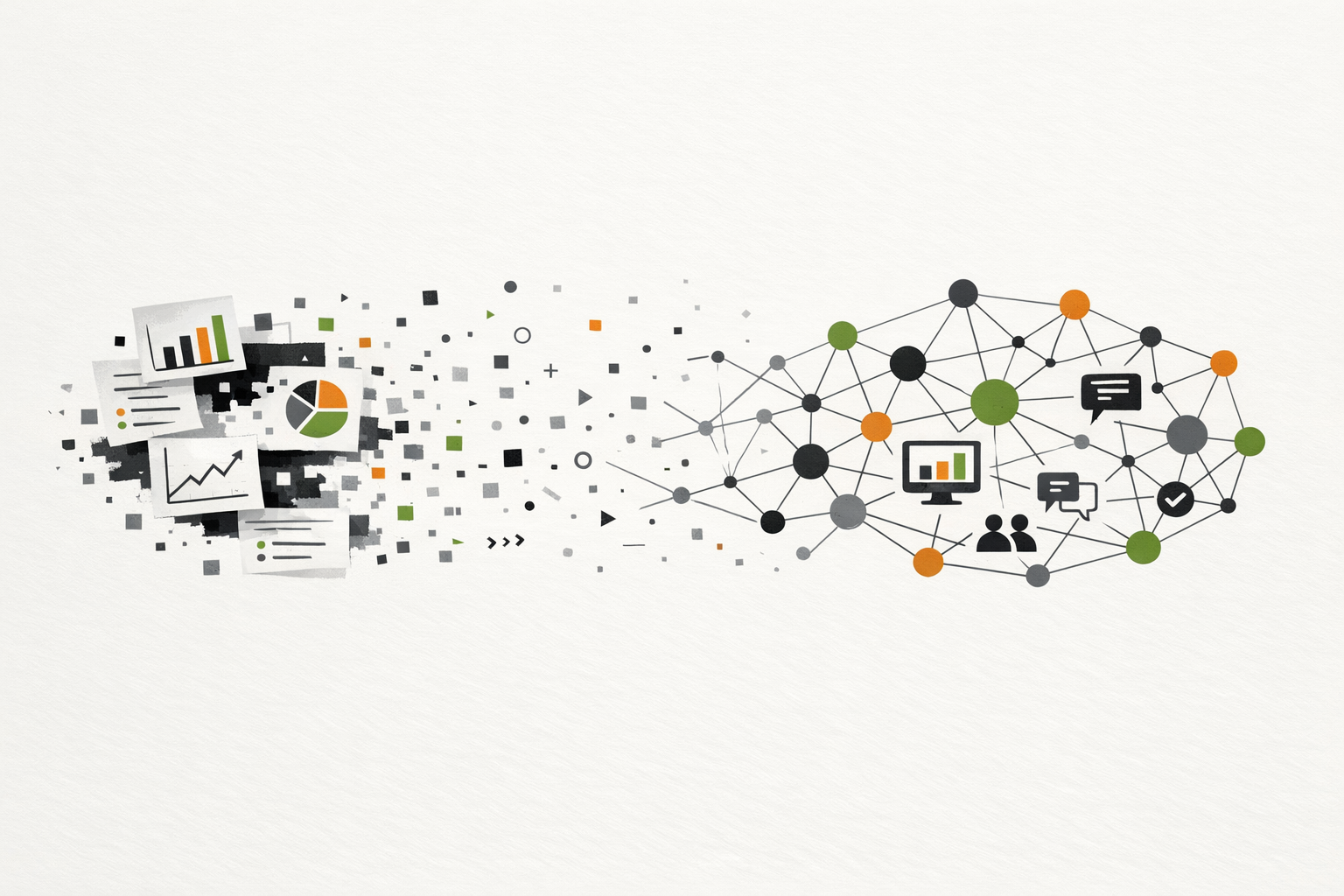
Presentation slides are not the enemy of sustainable foresight, but they can create a perception of “final delivery”, whereas the main benefits are received only after the discussions and decisions made on the topics introduced via slide set.
In fact, slides often work remarkably well at the beginning. When one or two people are scanning the horizon, interpreting signals, and translating insights into a narrative, a well-crafted deck can be enough.
The problem starts when the trend descriptions need continuous updates and notifications of the changes. More signals. More contributors. More stakeholders. More decisions depending on future-oriented insight. When foresight activities develop into practice, the team starts to wish for automation for the continuous simple tasks. When trying to scan the wide horizon, human biases become a concern as well.
At that point, slides might not work as a solution, and quietly become a constraint and burden for the foresight work.
When foresight starts to lose momentum
Most organizations do not notice the exact moment foresight stops working. They simply feel the symptoms. How many do you recognize:
-
Insights are repeatedly rediscovered instead of being used?
-
Signals are collected, but their relevance fades between cycles?
-
Different teams explore similar topics without knowing it (doing the same work twice)?
-
The reasoning behind conclusions is hard to reconstruct and links to original sources may be left out due to numerous updates?
-
Every reporting cycle feels like starting over?
In my experience, this is rarely a skill or methodology issue. It is almost always a structural one.
Slides, folders, and spreadsheets are designed to present outcomes. They are not designed to support continuous sense-making, collaboration, and learning over time. Foresight, however, requires exactly that: an ongoing process, not one-off deliverables.
Why scale changes everything
At small scale, folder structure with docs feels optional. At larger scale, this structure based on a cross-organisational database becomes decisive.
As foresight volume and participation increase, four pressures emerge:
-
Continuity pressure: Insights need to survive beyond a single project or presentation
-
Collaboration pressure: Analysis increasingly happens together, not sequentially
-
Traceability pressure: Decisions require a visible link back to evidence and assumptions
-
Shareability pressure: A need for visual communication of results (inside and outside of the organization) and reuse of results produced by others.
Slides are not built for long term standing of these pressures. They freeze thinking, require time for simple editing, instead of supporting learning. Slides separate analysis from dialogue. They privilege the final story over the underlying intelligence.
As a result, simple foresight updating tasks increase just when uncertainty, speed, and stakes increase.
The hidden cost of fragmented foresight
When foresight lives in personal folders or project-based decks, something subtle but damaging happens: the organization can lose its sensitiveness to change monitoring and memory becomes siloed.
Signals disappear when people leave. Assumptions fade from view. Past insights cannot easily be revisited, challenged, or connected to new information emerging through horizon scanning.
Over time, foresight turns into a series of disconnected efforts rather than a capability that compounds. This is often mistaken for a resourcing problem. In reality, it is an infrastructure gap.
What a shared foresight workspace actually enables
A shared workspace does not replace expertise or judgment. It supports them. At a minimum, it allows foresight teams to:
-
Store signals, trends, and analyses in one accessible place
-
Work collaboratively on interpretation, not just reporting
-
Maintain links between evidence, assumptions, and conclusions
-
Reuse and update insights instead of recreating them
-
Invite participation across functions without losing coherence
This is where foresight workflows begin to change. The work shifts from producing isolated outputs to maintaining a living system of futures intelligence.
Foresight platforms such as FIBRES are designed specifically for this kind of work: not only as reporting tools, but as shared environments where signals, analysis, and sense-making evolve over time and remain accessible to those who need them.
The shift is subtle but profound: Foresight moves from something that is delivered to something that is continuously informing wider organization and feeding the decision-making.
Structure as a signal of foresight maturity
One of the clearest indicators of foresight maturity is not methodological sophistication, but structural readiness. Mature foresight systems are designed to:
-
Support recurring practices rather than one-off projects
-
Make collaboration visible and traceable
-
Anchor insights directly into decision-making processes
-
Scale participation without diluting meaning
Slides still have a role to play. They remain useful for communication and storytelling. But they cannot carry the full weight of a foresight system once complexity, uncertainty, and organizational reach increase.
A question worth reflecting on
If your foresight efforts are growing, but impact feels harder to sustain, it may be time to look beyond outputs. Not to add more effort. Not to run more workshops. But to ask a simpler question: Is the way we structure foresight helping it learn and accumulate value, or quietly forcing it to reset every time?
To see how a purpose-built foresight platform can help you scale your foresight work's impact, why not book a demo of FIBRES with me?

Anna Grabtchak Client Executive at FIBRES, supporting foresight, strategy, and innovation teams in translating insights into actionable outcomes. She is also a doctoral researcher at the Finland Futures Research Center, where her work focuses on foresight maturity and the integration of futures intelligence into organizational strategy.
Stay in the loop
Get our latest foresight tips delivered straight to your inbox. You may unsubscribe from these communications at any time.