
Impactful foresight needs more than generic AI
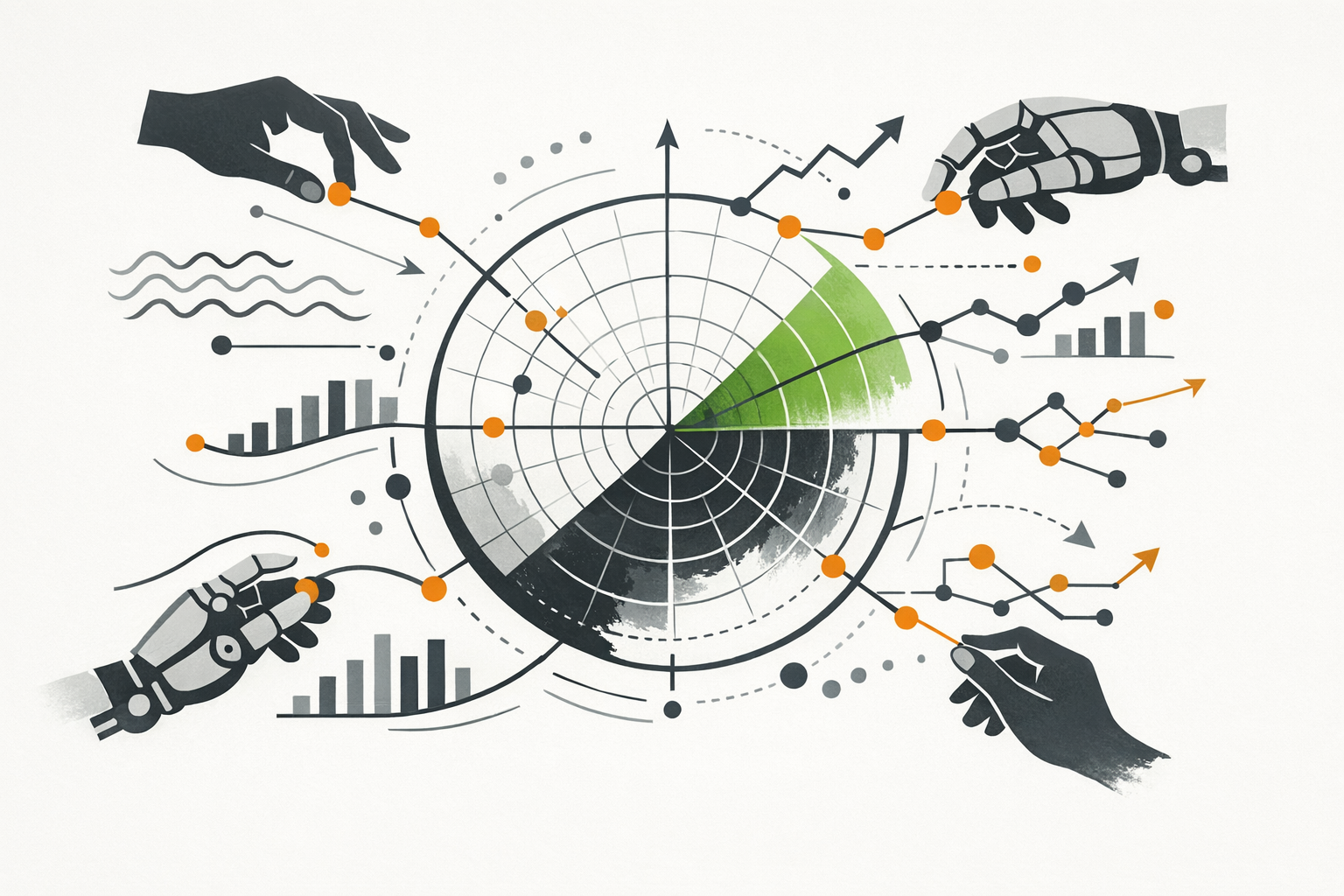
Over the past year, many teams working in strategy, innovation, and foresight have started experimenting with generic AI tools and large language models.
The appeal is obvious in the field of foresight. These tools are fast, accessible, and often genuinely useful. They help summarize information, generate ideas, and make it easier to get started.
But after the initial enthusiasm, a strategic question tends to emerge:
If everyone has access to the same AI models, where does our foresight edge actually come from?
Because in foresight, speed is not the goal. The goal is to make better decisions under uncertainty. And that requires more than fast answers or a false feeling of certainty.
When AI becomes infrastructure
As AI becomes widely accessible, something important changes. It stops being a differentiator.
When the same models, prompts, and data are used across organizations, insight generation itself starts to commoditize. Teams produce similar trend lists, similar observations, and similar narratives about the future. This may still look impressive, but it does not create competitive advantage.
The edge shifts elsewhere: into how questions are framed, what signals are prioritized, and how insights are interpreted within a specific context Foresight becomes less about generating content, and more about building distinct understanding and action.
What you scan shapes what you see
At the core of foresight is a simple principle: you cannot see what you are not scanning for.
Generic AI tools rely heavily on broadly available web knowledge. This naturally emphasizes signals that are already visible and widely discussed. Many early signs of change emerge in niche communities, expert conversations, local contexts, and lived experience long before they appear in searchable sources.
Weak signals rarely arrive as clear, well-documented trends. They are scattered, ambiguous, and easy to miss.
This is why foresight depends not just on analysis, but on curated and diverse signal sources. The quality of insight is shaped by the quality and breadth of what is being observed.
Not all signals exist online
There is another limitation that becomes clear in practice. Some of the most important signals of change do not exist as data yet.
They appear first in conversations, in early experiments, in shifts in behavior, or in subtle changes in how people think and act. They are often felt before they are documented.
AI can scale what is already visible. But humans are still essential for sensing and accessing what is just emerging.
This is not a limitation of technology. It is a reminder that foresight is not purely analytical. It is also experiential.
From answers to continuous intelligence
Most interactions with generic AI are episodic. A question is asked, an answer is generated, and the interaction ends.
Foresight, however, is not a series of isolated questions. It is an ongoing process of tracking how change unfolds over time.
Signals evolve. Trends shift. Assumptions need to be revisited. This requires continuity. It requires systems that allow signals to be monitored, insights to be updated, and knowledge to accumulate. Without that, foresight remains fragmented: useful in moments, but difficult to sustain.
Depth matters many times more than speed
Generic AI tools are optimized for efficiency. They are designed to reduce effort and deliver fast results.
But foresight often requires something different: depth.
Early change rarely reveals itself through a small set of sources. It requires scanning broadly, connecting patterns, and working with incomplete information.
The difference between a quick answer and a meaningful foresight insight is often the difference between surface-level synthesis and deep, structured exploration.
From fragmented work to structured intelligence
In many teams, foresight still involves a surprising amount of manual effort. Insights are generated in one place, copied into another, shaped into slides, and shared across disconnected tools. Over time, this creates fragmented knowledge, lost context, and work that is difficult to build on.
The rise of generic AI tools can make this even more fragmented. Instead of strengthening shared thinking, people often end up working in parallel, each having private conversations with their own AI tools. Useful reflections may be generated, but they remain siloed, invisible to the team, and disconnected from a broader process of collective sensemaking.
What is needed instead is a more structured approach: a system where signals, trends, and interpretations are captured, shared, and connected in one place. A system where insights do not disappear after a project or stay buried in individual chats, but can evolve over time.
This is where foresight starts to compound in value.
Foresight is a capability, not a tool
At a certain point, the conversation moves beyond AI tools. Because foresight advantage does not come from tools alone. It comes from capability.
A fool with a tool, is still a fool. As they say.
Organizations that benefit from foresight tend to build shared processes for interpreting change. They connect insights to decisions. They involve multiple perspectives and continuously revisit their assumptions and prepare for alternative futures.
AI can support this work. But it cannot replace it.
The role of human judgment
As AI scales, the role of humans becomes more focused, not less.
AI can scan, summarize, and cluster information. But humans provide context, judgment, and meaning. They decide what matters, what is relevant, and what should be acted on. And unlike AI, humans must live with the consequences of decisions made.
This is where foresight becomes valuable: not in generating insights, but in making sense of them.
Why purpose-built foresight platforms matter
This is where a purpose-built foresight platform makes a real difference.
FIBRES is a platform built specifically for strategic foresight capability building. Instead of acting as a generic AI tool, it helps organizations scan change, interpret signals, and turn insights into shared understanding over time.
FIBRES Foresight Agents use a quality-controlled source base rather than relying on the open web alone. This improves the relevance and traceability of insights and gives teams more control over the intelligence they build on.
Security is another essential part of this foundation. All FIBRES AI runs inside a secure cloud environment, and user data is never used for model training.
And because foresight is a team effort, the platform is built to support collaborative sensemaking on-platform. Teams can work from shared signals, connected insights, and real-time updated visuals, helping them move from isolated observations to shared understanding.
This is what purpose-built foresight infrastructure enables: not just faster outputs, but a more trustworthy, collaborative, and continuously evolving foresight capability.
From outputs to systems
The real shift is not simply from “no AI” to “AI.” It is from isolated outputs to living systems.
Generic AI can produce useful answers on demand. But foresight creates value only when those answers are captured, connected, and revisited over time. Instead of relying on static reports or one-off analyses, organizations need systems where signals are continuously monitored, trends evolve, and insights remain linked to their underlying evidence.
That is what turns foresight from occasional output into an ongoing capability for better decisions under uncertainty.
Final thought
Generic AI has made foresight more accessible. But it has also raised the bar.
If everyone can generate insights, then advantage no longer comes from generating them. It comes from how those insights are built, connected, and used over time.
The question today is whether we are using AI to get quick answers or to build a deeper capability to understand change.
That is where impactful foresight begins.
If this resonates with you, I warmly encourage you to book a personal walkthrough of our foresight platform, purpose-built to help organizations achieve exactly that.

Sakari Nisula Head of Customer Success & Foresight at FIBRES. Combining experience from academia and business, he is a hands-on foresight practitioner helping organizations navigate emerging trends, build future-oriented strategies, and foster innovation. He also brings an AI-forward lens to foresight, exploring how human–AI collaboration can accelerate futures intelligence without losing human judgment and purpose.
Stay in the loop
Get our latest foresight tips delivered straight to your inbox. You may unsubscribe from these communications at any time.