
From insight to impact: How AI is changing foresight consulting and why the human side matters more than ever
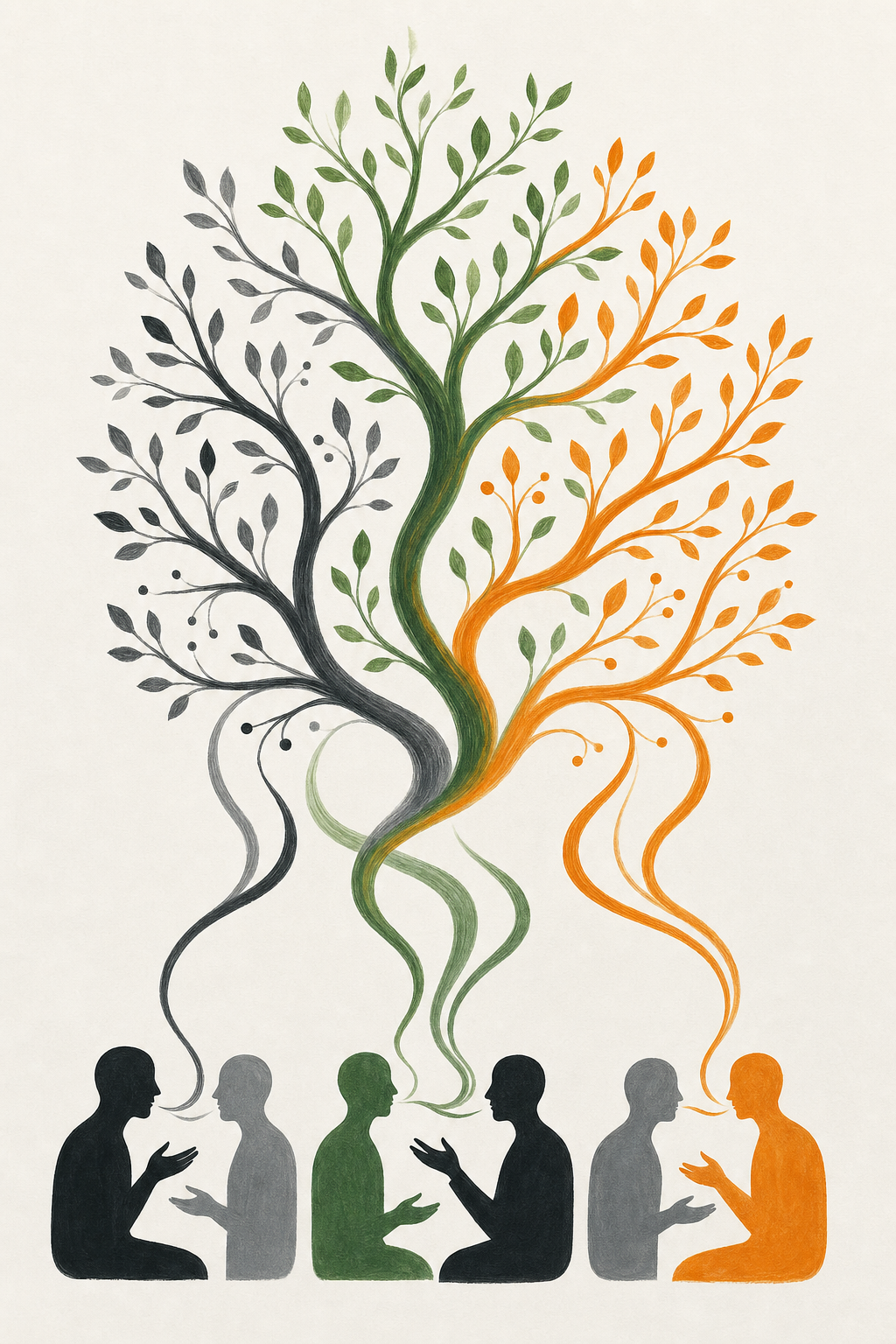
Reflections from a conversation with a Big Four futurist
AI can scan thousands of sources, summarize weak signals, cluster trends, and draft scenarios in minutes. Yet many organizations still struggle to turn foresight into action.
That tension became the starting point for a recent discussion I had with Chris, a futurist working at Foresight.EY within EY’s Office of the Chief Technology Officer. We had briefly touched on the changing role of foresight during our conversations, especially the growing pressure to move beyond reports and toward deeper strategic influence.
The discussion quickly expanded into something bigger: How does foresight evolve when information becomes abundant? What happens to consulting when AI accelerates analysis faster than organizations can absorb it? And why do imagination, storytelling, and emotional connection suddenly feel more important instead of less?
What follows is a reflection on that shift: from foresight as a way to observe change toward foresight as a way to help organizations make sense of uncertainty, connect it to decisions, and build the confidence to act.
Finding a profession that matched the way he saw the world
I asked Chris what originally pulled him into futures work. His answer had very little to do with frameworks or methodologies.
“My tech career probably would’ve been pretty short if I hadn’t found innovation work, especially futures,” he told me. “It was the first area that actually felt aligned with how my brain works and how I naturally see the world.”
He described constantly needing to understand the bigger picture before he could meaningfully engage with the work in front of him.
“I couldn’t just focus on the deliverable without understanding why it mattered in the first place,” he said. “I’d keep asking questions until I eventually got to the larger vision of where the business was trying to go and what it was trying to become.”
That felt familiar to me.
Many people who end up in strategic foresight start from curiosity long before they discover the field itself. They are usually the people who cannot stop asking where things are heading, why systems behave the way they do, and what assumptions everyone else is quietly treating as fixed.
Chris described futures thinking as something that gave him permission to begin from possibilities rather than constraints.
“Futures lets me start there from the beginning,” he said. “It gives me room to think creatively, explore ideas that don’t exist yet, and bring my own perspective into the work.”
Inside large consulting environments, that perspective has become increasingly valuable because clients themselves are changing.
Everyone suddenly feels closer to the future
One of the more interesting observations Chris made was how AI has shifted the tone of client conversations.
“Everyone feels like a futurist now,” he said. “The conversations have become more imaginative, more ambitious, and much more centered on real disruption instead of disruption as a buzzword.”
That line stayed with me because it captures something many foresight professionals are experiencing right now: Long-term thinking no longer feels distant.
Change has become tangible. The future version of industries, organizations, and work itself suddenly feels uncomfortably close. New capabilities appear almost weekly. Leadership teams are trying to understand whether their assumptions about products, customers, expertise, or competitive advantage still hold.
According to Chris, that pressure changes both the expectations placed on consultants and the role of foresight itself.
“People are being forced to think more like futurists,” he said. “Not because it’s trendy, but because the pace of change is making long-term thinking feel immediately relevant.”
At the same time, clients are far less impressed by static trend reports than they used to be.
Simply extracting information from the world and packaging it into slides no longer creates much value on its own. Leaders already have access to endless information streams, AI-generated summaries, and constant commentary.
The real challenge now is helping organizations interpret signals, make sense of uncertainty, and connect emerging change to decisions they actually need to make. That is where foresight work starts becoming operational instead of observational.
Foresight cannot sit in a separate thought leadership bubble anymore
In many organizations, foresight has traditionally lived slightly outside the core business.
Interesting. Inspiring. Occasionally influential. But often disconnected from execution.
I mentioned to Chris that I increasingly see foresight shifting from a specialist activity into something closer to a continuous organizational capability. Less project-based. More embedded into how decisions are made.
He agreed, and his response was strikingly direct.
“We can’t operate in a separate thought leadership bubble anymore,” he said. “The era of talking about theoretical futures without connecting them to execution is mostly gone.”
The organizations gaining the most value from strategic foresight today are not treating it as an annual trend exercise or a standalone innovation workshop. They are building ongoing futures intelligence capabilities around continuous horizon scanning, collaborative sensemaking, and decision support. A real foresight system.
The interesting part is that AI is accelerating this transition.
Organizations can now monitor change continuously instead of periodically. They can track emerging signals, public sentiment, technology shifts, policy developments, and market movements in near real time. AI-assisted horizon scanning and clustering make it possible to process far larger information environments than foresight teams could handle manually.
But the technology itself does not automatically create clarity.
Someone still needs to connect those signals to strategy, priorities, risks, investments, and organizational realities.
“The front end of innovation can’t sit apart from core business strategy anymore,” Chris said. “It has to be connected directly to execution, supported by real-time analysis, feedback, and adaptation.”
That observation mirrors many conversations we are having with at FIBRES.
The strongest teams today are moving toward living foresight systems instead of one-off deliverables. They are building shared platforms where scanning, trend analysis, collaborative interpretation, and strategic conversations continue over time instead of restarting from scratch every quarter.
The pace of change no longer allows organizations to stop paying attention between reporting cycles.
AI is changing the practice of foresight
I was curious how Chris personally experienced the rise of generative AI inside futures work.
His answer was nuanced.
“I feel like my career has evolved alongside AI,” he said. “Back then, my value came from connecting dots and imagining possibilities. As AI has evolved, that kind of ideation became faster and more accessible to everyone.”
That shift could easily be misunderstood as a loss of value for consultants, foresight practitioners, or strategists. But Chris described the shift differently.
“What used to take hours of thinking can now happen in seconds,” he said. “Today, the value feels more about helping people make sense of ideas, connecting foresight to reality in a way that’s actionable and human.”
That distinction feels important.
AI compresses parts of foresight work that used to require enormous manual effort. Tasks such as horizon scanning, weak-signal monitoring, summarization, clustering, drafting, first-pass scenario generation, and synthesis across large datasets can now happen faster and at greater scale than before. Those capabilities matter. They dramatically expand what small foresight and innovation teams can accomplish.
But they also change where human value sits. Chris described his role today as something closer to a guide than a pure expert.
“Now I see myself as a futures guide,” he said. “Educating, advocating, connecting, relationship building, product creating.”
The consultant increasingly becomes someone who helps organizations navigate uncertainty instead of simply delivering analysis about it.
The futurist becomes someone who helps leadership teams ask better questions, frame possibilities, challenge assumptions and cognitive biases, and build enough shared understanding to move.
And in practice, those conversations are rarely driven by data alone.
Chris captured the deeper human dimension of this shift in a more philosophical way:
“Humans remain, for now and hopefully ever, the spiritual vessel allowing new ideas to flow into our experienced reality.”
The human edge: why emotion and imagination suddenly matter more
At some point, we moved beyond AI itself and into a deeper question: why does the human side of foresight become even more important as technology advances?
I shared a thought that has become increasingly central in my own work. Decision-makers often do not struggle because they lack information. They struggle because uncertainty creates hesitation. More information can sometimes deepen that hesitation instead of resolving it.
Chris immediately connected with that tension.
“Your human presence is still one of your biggest advantages,” he said. “The real impact comes from storytelling that creates genuine connection, not just delivering information.”
That distinction becomes more important in an AI-driven world.
When everyone has access to information, summaries, and predictions, the differentiator increasingly becomes interpretation, emotional resonance, and the ability to make a future feel tangible enough that people are willing to act.
Chris mentioned about how much influence lives in details that rarely appear in strategy documents.
“Eye contact, tone, pacing, energy, emotion,” he said. “The way something is said can matter just as much as the content itself.”
That may sound obvious outside business contexts, but organizations often behave as if strategy decisions emerge through purely rational evaluation. They do not.
Leaders are still human beings navigating ambiguity, biases, pressure, ambition, and uncertainty. Strategic decisions often depend on whether people can emotionally connect with a future scenario strongly enough to prioritize it. This is one reason foresight workshops and strategy sessions are changing.
Static presentations increasingly fall flat. Interactive foresight experiences, scenario exercises, collaborative workshops, speculative artifacts, and immersive storytelling create different kinds of engagement because they help participants mentally step inside possible futures instead of simply hearing about them.
Chris put it beautifully.
“If you can tell a story in a way that someone personally connects with, that’s what creates movement,” he said. “That’s what makes people care enough to actually act on an idea.”
That sentence captures a major shift happening inside consulting and foresight right now.
The work is becoming less about delivering information and more about helping organizations make sense of change and act on it.
From expert outputs to shared futures capability
The shift toward more human and relational foresight work is also changing where foresight sits inside organizations.
Traditional consulting models often positioned the expert as the source of answers. Futures work increasingly operates differently. The more uncertain the environment becomes, the harder it is for any individual expert to interpret it alone. Valuable signals are distributed across organizations—within R&D teams, customer conversations, risk functions, innovation groups, strategy discussions, frontline observations, and external ecosystems.
The challenge is rarely a lack of information; it’s usually fragmented interpretation.
This is why collaborative foresight is becoming increasingly important. Instead of relying on isolated expert outputs, organizations need shared ways of interpreting change, challenging assumptions, and connecting emerging developments to strategic decisions.
Chris described this process as deeply human at its core.
“New ideas are perpetual and still feel deeply human,” he said. “People naturally keep searching for the next question, the next possibility, and the next step forward.”
That search becomes more valuable when organizations create spaces where people can participate in it together. The futurist’s role is therefore not only to provide an outside perspective, but to help different parts of an organization build shared understanding and contribute their own knowledge to the foresight process.
This is also where modern foresight platforms are changing the day-to-day reality of the work. Instead of scattered documents, disconnected workshops, and static reports, teams increasingly need living systems where signals, trends, strategic assumptions, visualizations, conversations, and decisions remain connected over time.
That continuity matters because foresight compounds.
Systematic scanning and collaborative interpretation become more valuable as organizational memory develops. Teams begin recognizing patterns earlier, weak signals become easier to contextualize, and previous assumptions and decisions remain visible rather than disappearing when a project ends.
Over time, foresight starts functioning less like a standalone project and more like organizational infrastructure.
As foresight becomes more continuous, collaborative, and embedded in decision-making, the role of the futurist evolves as well. Based on our conversation, I would summarize the shift like this:
|
Less time spent on... |
More value created through... |
|
Providing information |
Facilitating strategic dialogue |
|
Researching trends |
Acting as a futures guide |
|
Producing reports |
Enabling collective sensemaking |
|
Writing scenarios |
Storytelling and meaning-making |
|
Observing from the outside |
Building organizational foresight capability |
|
Analysing change |
Building agency |
|
Consulting as an external expert |
Becoming a trusted partner in uncertainty |
The future of foresight is not about producing more insights. It is about helping people turn futures intelligence into understanding, decisions, action, agency, and impact.
This shift also raises a more uncomfortable question about what consulting and foresight teams may need to leave behind.
Toward the end of our discussion, I asked Chris what traditional foresight activity he would stop if he could, and what should replace it. His answer focused less on a particular method and more on mindset.
“Futures thinking is more a way of seeing the world than a discipline you turn on and off,” he said. “It’s constant.”
If there was one thing to leave behind, it might be the assumption that foresight can exist as a standalone activity. The future of the discipline is unlikely to be built on isolated reports, periodic trend exercises, or thought leadership disconnected from decisions. The work increasingly needs to live inside strategy, operations, and everyday conversations about change.
Organizations can still produce trend reports, scenarios, innovation decks, and thought-leadership pieces. Those formats are not disappearing. But their usefulness depends on whether they connect to real strategic conversations, operating decisions, and human concerns.
A report may provide a temporary view of change. A shared foresight capability helps an organization continue noticing, interpreting, and responding as conditions evolve.
Chris emphasized that futures work has always carried something deeply human underneath it.
“At its core, futures work has never really been about short-term growth or sales targets,” he said. “It’s been driven by curiosity, creativity, and people trying to make sense of where society is headed.”
That may be exactly why the human side of foresight becomes more valuable as AI capabilities expand.
When information becomes abundant, attention shifts toward meaning. When analysis becomes faster, interpretation becomes harder.
And when organizations can access almost unlimited signals, the difficult part becomes deciding which changes matter, which possibilities deserve attention, and which futures are worth committing energy and action toward.
A final reflection
One thing I kept returning to after this discussion was how differently foresight conversations feel today compared with even a few years ago.
The field feels less academic, less isolated, and less comfortable remaining at the edge of strategy discussions. There is more urgency, but also more openness.
Organizations are becoming more willing to question assumptions, experiment with collaborative foresight, integrate AI-assisted workflows, and treat futures intelligence as an ongoing capability rather than an occasional exercise.
Yet the conversations that create real movement still tend to be deeply human.
People remember stories.
They remember moments when a possible future suddenly felt tangible.
They remember conversations that made uncertainty understandable enough to act on.
As Chris said during our discussion:
“The strongest futures communities are deeply human ones built around imagination, connection, and a genuine desire to shape a better future.”
Perhaps that is the central lesson of this shift. As AI becomes more capable of generating futures intelligence, the value of foresight increasingly lies in helping people interpret change, build shared understanding, and develop the agency to act.
That matters not only for consultants and futurists, but for any organization seeking to make better decisions under uncertainty and shape the future rather than simply react to it.
If this article resonated with you, you’re probably thinking about the same challenge we are: how to make foresight an ongoing capability instead of another report.
If you’d like to see how organizations are using FIBRES to build collaborative, AI-assisted foresight systems that connect signals, trends, and strategic decisions, we’d be happy to show you. Book a personalized demo and explore what modern foresight can look like in practice.
Chris Kubik
Manager, Office of the CTO, Foresight.EY

Sakari Nisula Head of Customer Success & Foresight at FIBRES. Combining experience from academia and business, he is a hands-on foresight practitioner helping organizations navigate emerging trends, build future-oriented strategies, and foster innovation. He also brings an AI-forward lens to foresight, exploring how human–AI collaboration can accelerate futures intelligence without losing human judgment and purpose.
Stay in the loop
Get our latest foresight tips delivered straight to your inbox. You may unsubscribe from these communications at any time.