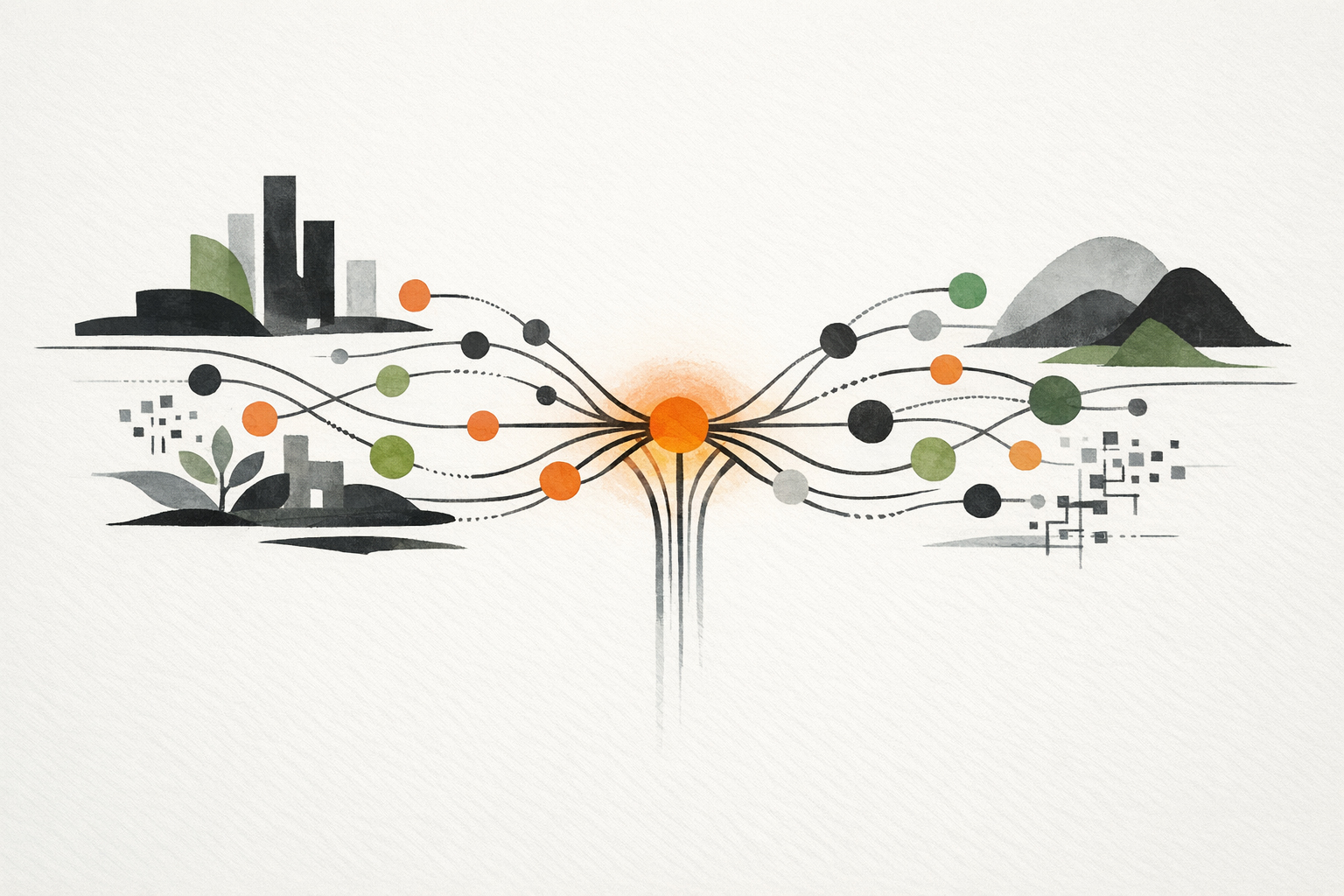
Foresight has outgrown the workshop room. The next challenge is no longer only how one organization understands change, but how entire ecosystems learn to observe, interpret, and act on it together.
At FIBRES, we are joining the FORECO project to explore this shift in practice: how strategic foresight can move from isolated activities toward shared, ecosystem-level capability.
Why this moment matters
Organizations across industries are investing in strategic foresight, horizon scanning, and futures intelligence. At the same time, the environment they operate in has become deeply interconnected.
Innovation happens across networks. Risks propagate through supply chains. Regulation, technology, and markets evolve together.
Yet foresight often remains internal. Anna Grabtchak, Client Executive at FIBRES, reflects on this tension:
Preferable futures are not built in isolation. The real question is: how do we design ways of working where multiple actors can shape them together?
For strategy, innovation, risk, and R&D teams, this creates a practical challenge. It is no longer enough to identify signals early. The real question is how to turn distributed knowledge into shared understanding, and ultimately into decisions.
From individual foresight to ecosystem foresight
FORECO, short for Foresight in Ecosystems, brings together companies, research institutions, and foresight practitioners to examine how collaborative foresight can be practiced across organizational boundaries.
The starting point is familiar:
-
Strategic foresight is increasingly used inside organizations
-
Business is increasingly conducted within ecosystems
-
Foresight is still rarely done together
This gap is where many foresight efforts lose impact. Panu Kause, CEO at FIBRES, describes the direction of travel:
We’re already seeing foresight becoming more collaborative across ecosystems. If this continues, it could evolve into something as impactful as open innovation did.
The implication is clear. If foresight remains siloed while decision-making becomes more distributed, the connection between insight and action weakens.
What FORECO explores
The project moves beyond producing trend lists or scenarios. It focuses on how foresight operates in practice when multiple actors are involved.
This includes questions such as:
-
How do ecosystems carry out horizon scanning and weak signal detection together
-
How are signals, trends, and insights shared and interpreted across organizations
-
How does foresight connect to real decision-making processes
-
How can AI support continuous sensing and sensemaking without removing human judgment
-
How are governance, data ownership, and trust structured in shared foresight work
At its core, FORECO examines foresight as a system, not a deliverable.
The role of FIBRES
Within the project, FIBRES participates in the steering group and contributes as an in-kind partner.
This contribution is intentionally practical. Selected FIBRES capabilities are made available to participants to test and adapt in real ecosystem settings. This includes support for horizon scanning, signal collection, AI-assisted analysis, and collaborative trend and radar work.
“We’re bringing FIBRES into the project as a test environment, so participants can actually try out ecosystem-level foresight in practice, not just discuss it”, Panu explains the approach.
At the same time, the project serves as a learning environment for us. “We’re especially interested in the less visible parts: governance, data ownership, trust, incentives. These are often where collaboration either works or breaks”, he continues.
At FIBRES, these questions are closely connected to how we design foresight workflows: how signals become structured intelligence, how teams collaborate around trends, and how insights remain traceable when used in decision-making.
What we want to understand
A central focus of the project is how foresight changes when it moves beyond a single organization. Anna frames it as a systems question:
What does it actually take to make foresight work between organizations, not just within them?
This includes:
-
How foresight activities are structured across actors
-
How roles and responsibilities are defined
-
How shared taxonomies and interpretations are built
-
How foresight outputs remain connected to decisions over time
It also brings attention to a familiar challenge inside organizations. As Anna points out, “many foresight efforts remain disconnected from decisions and from each other. Without integration, it’s difficult to create lasting value.”
Extending foresight into ecosystems makes this challenge more visible, but also more addressable.
What this means for foresight practice
If collaborative foresight becomes more common, it will change how organizations approach futures intelligence.
Instead of:
-
Periodic foresight projects
-
Static reports and presentations
-
Insights held within small expert teams
We may see:
-
Continuous horizon scanning across shared sources
-
Living trend and signal libraries used by multiple actors
-
Collaborative sensemaking supported by AI
-
Dynamic trend and technology radars aligned across organizations
-
Clear links between foresight inputs and strategic decisions
This is not only a methodological shift. It is also a cultural and structural one.
Looking ahead
FORECO is a two-and-a-half-year research and co-innovation effort. The questions it addresses will likely extend far beyond the project itself.
Panu puts it simply: “Just look at what happened with open innovation. If collaborative foresight follows a similar path, do you want to be early, or catching up?”
For us at FIBRES, participating in FORECO is an opportunity to contribute to this development in a concrete way, by testing how foresight can be practiced as a shared, evolving capability across ecosystems.
If you are working on strategic foresight, innovation, or risk, and are exploring how to make foresight more collaborative, continuous, and connected to decisions, you can learn more about how FIBRES supports horizon scanning, trend radars, AI-assisted workflows, and shared futures intelligence on our foresight platform.
The future is shaped through decisions. Increasingly, those decisions are not made alone.
What is FORECO?
FORECO, short for Foresight in Ecosystems, is a multidisciplinary co-innovation project exploring how organizations can practice strategic foresight together across ecosystems.
The project focuses on a growing gap in today’s business environment: while companies increasingly invest in foresight, collaboration on futures thinking across supply chains and ecosystems remains rare.
FORECO addresses this by examining:
- How foresight can support ecosystem-level decision-making
- How organizations can share signals, trends, and insights securely
- How AI and data infrastructures can enable joint sensing and sensemaking
- How ecosystems can move from reacting to change to actively shaping markets
The initiative brings together leading industrial companies, foresight and AI experts, and academic research partners, including VTT, LUT University, and the University of Turku.
Running from January 2026 to June 2028, FORECO aims to strengthen how ecosystems anticipate and create future demand in international markets.
Learn more about the project and how to get involved on the official FORECO website.