
Introducing Living Radars, powered by FIBRES Foresight Agents
Most foresight radars start becoming outdated the moment they are published. The research may be solid. The trends may be carefully assessed. The radar may give everyone a clearer view of what matters. Then the world keeps moving.
New signals appear. Technologies mature. Regulations change. Competitors make moves. Risks develop. What looked distant starts accelerating. Something nobody was tracking suddenly deserves attention. But the radar stays where it was.
Keeping it current has traditionally meant another round of scanning, sorting, analysis, writing, workshops, and updates. For teams already stretched thin, that work is difficult to sustain continuously. So foresight tends to happen in projects. Scan. Build the radar. Share the findings. Use them in planning. Come back months later and figure out what changed.
We think the radar itself should keep evolving.
Today, we’re introducing Living Radars in FIBRES, powered by FIBRES Foresight Agents: an AI-assisted workflow for designing a foresight radar around your own intelligence needs, building it ground-up from real-world evidence, and keeping it up to date as new developments emerge.
Go from an initial research question to a fully populated first-draft radar in under an hour. Then bring Foresight Agents back whenever you need to scan again, find out what changed, and get evidence-backed suggestions for how your radar should evolve.
Foresight Agents scan 200,000+ source publications to find signals relevant to your research questions and strategic context. The result isn’t a generic trend library or someone else’s view of the future. It’s your own futures intelligence, built around what your organization needs to understand.
→ Book a demo to see FIBRES and Foresight Agents it in action
From static foresight radars to living futures intelligence
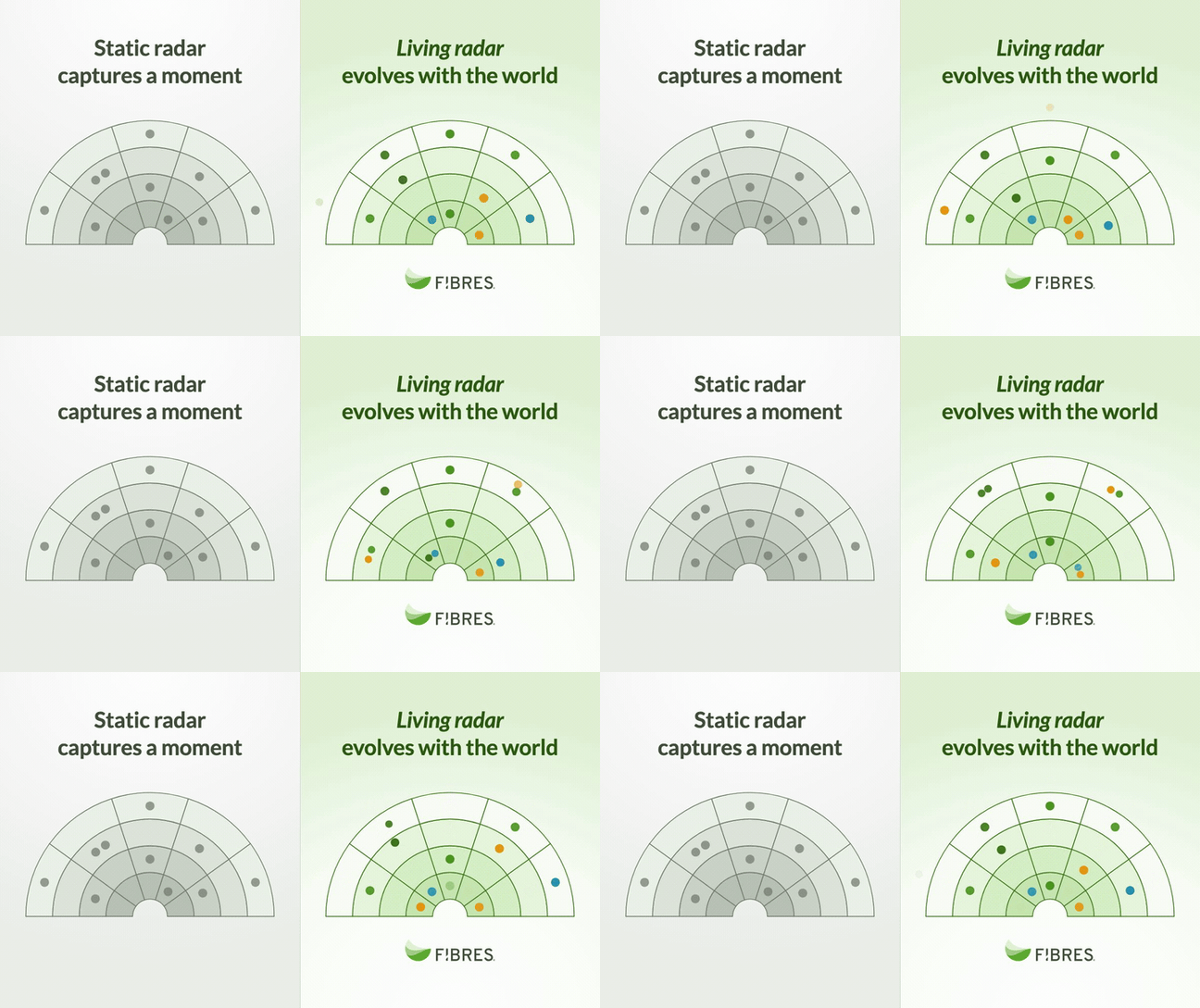
A conventional radar is a snapshot. That can be perfectly useful. The problem starts when the snapshot is still guiding decisions long after the underlying evidence has changed.
⏵ A technology radar created nine months ago does not know that a promising technology has stalled, a new approach has emerged, or commercialization has accelerated.
⏵ An emerging risk radar does not automatically notice a new regulation, geopolitical development, or cluster of weak signals.
⏵ An innovation radar cannot tell you that an opportunity space is becoming more crowded or that a previously marginal customer behavior is gaining momentum.
Someone has to go looking.
This is where continuous foresight has traditionally become expensive. The research itself takes time, and every update brings more work: finding relevant sources, separating useful signals from noise, comparing new evidence with existing intelligence, updating descriptions and assessments, and documenting why something changed.
Living Radars are designed to make that cycle practical.
FIBRES is a foresight platform that combines purpose-built radar design, automated horizon scanning, AI-assisted analysis, human review, and continuous radar updates in one foresight workflow, making continuous foresight not only possible for all but practical as well.
Here’s how it works.
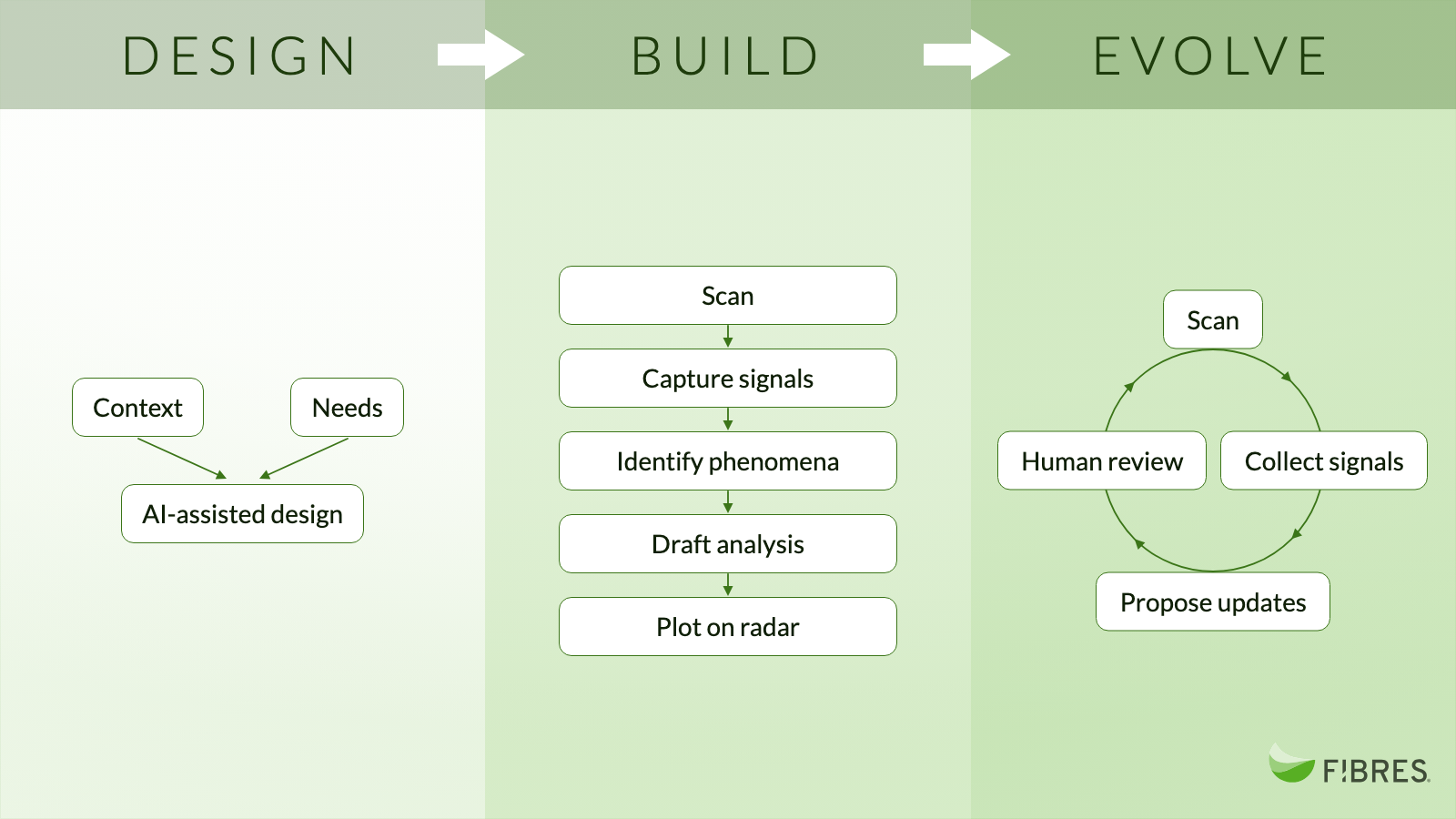
1. Design a foresight radar around what you actually need to know
There is no universal radar that fits every organization.
A technology scouting team deciding where to place R&D bets needs a different structure from a risk team monitoring regulatory change. A strategy team exploring the future of a market has different questions from an innovation team looking for emerging customer needs.
That’s why a Living Radar starts with your purpose and context.
FIBRES’ built-in, foresight-native AI assistance helps you turn an intelligence need into a radar designed for the job. You can define the scope, structure, categories, time horizons, evaluation criteria, or other dimensions that matter to your team.
You might build a:
-
Strategic trend radar
-
Technology radar
-
Emerging risk radar
-
Innovation opportunity radar
-
Market or industry radar
-
Radar based on your own foresight framework or taxonomy
-
… or a radar for anything future-oriented you wish to explore
You decide what belongs on the radar and how it should be assessed. The AI helps with the setup so you don’t have to start with an empty canvas or force your work into a predefined trend framework. And the same principle applies to the research that follows.
2. Let Foresight Agents do the horizon scanning and build the first draft
A well-designed empty radar is still an empty radar. Populating it has traditionally required the most labor-intensive part of foresight: horizon scanning. Searching. Reading. Collecting signals. Comparing sources. Identifying patterns. Grouping related developments. Drafting trend descriptions. Deciding what deserves a place on the radar.
FIBRES Foresight Agents can now do much of that work for you.
Give a Foresight Agent the research task and prepare a research plan collaboratively with it, and it will scan large volumes of source material, identify relevant signals and developments, cluster the findings, draft radar items and place them on the radar. The result is a fully populated first draft that your team can inspect, challenge, edit, and develop further.
And importantly, this is not a generic trend library being repackaged as your foresight. Foresight Agents research the topics you ask them to research on-demand. Not based on pre-filtered view of the world someone else has designed. Not borrowing from a pool of pre-written analysis that everyone else also has access to.
Your industry. Your technologies. Your markets. Your risks. Your strategic questions. Your chosen scope. Your context and research goals.
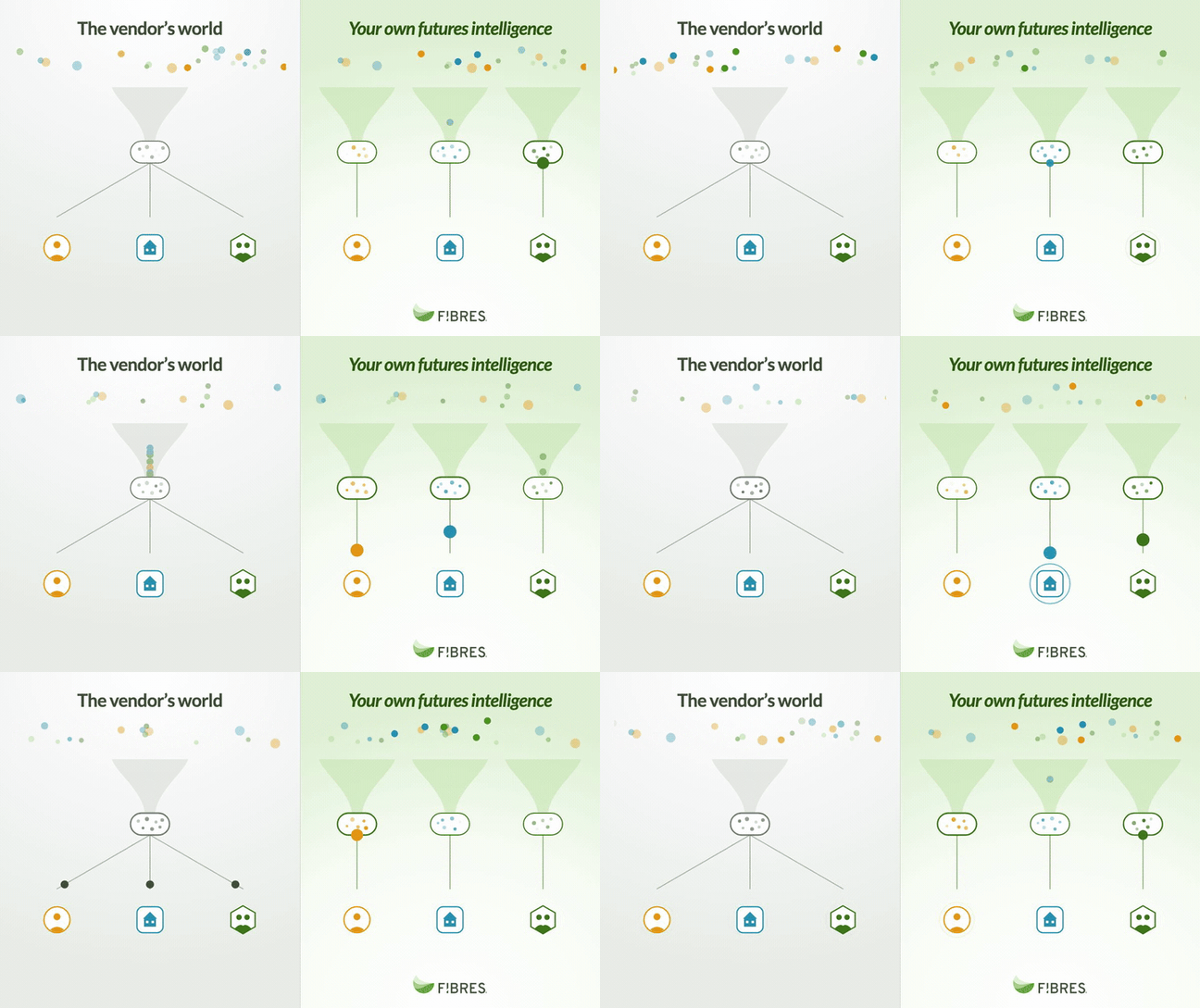
The radar is built from research carried out for your specific intelligence need, with the underlying evidence available for review. That makes a significant difference to what teams can practically investigate. A radar no longer needs to justify weeks of manual research before you even know whether the topic is worth exploring.
You can go from an idea to a fully populated first-draft foresight radar in under an hour. Your experts can then spend their time where their expertise matters: evaluating what the evidence means, challenging the analysis, adding organizational knowledge, and deciding what deserves attention.
3. Keep your radar up to date with Foresight Agents
Building the radar is only the beginning. Three months later, the useful question is no longer What did we find? It’s What has changed?
Living Radars let you return to an existing radar and use Foresight Agents to run another horizon scan against the topics you’re already monitoring. The Agent looks for new evidence and developments and compares what it finds with the intelligence already on your radar.
It will propose:
-
New signals and evidence
-
Updates to existing radar items
-
Changes to radar positioning and assessments
-
New topics that deserve a place on the radar
-
Reasoning and source evidence behind the proposed changes
You review the proposed changes before they become part of your radar. Approve what makes sense. Reject what doesn’t. Refine the analysis with the context and judgment that only your team has.
This creates a practical update loop: scan again, see what changed, review the evidence, update the radar. Run it when you need a fresh view or make periodic horizon scans part of your foresight process throughout the year. Instead of rebuilding your intelligence from scratch every time, you keep developing what you already know.
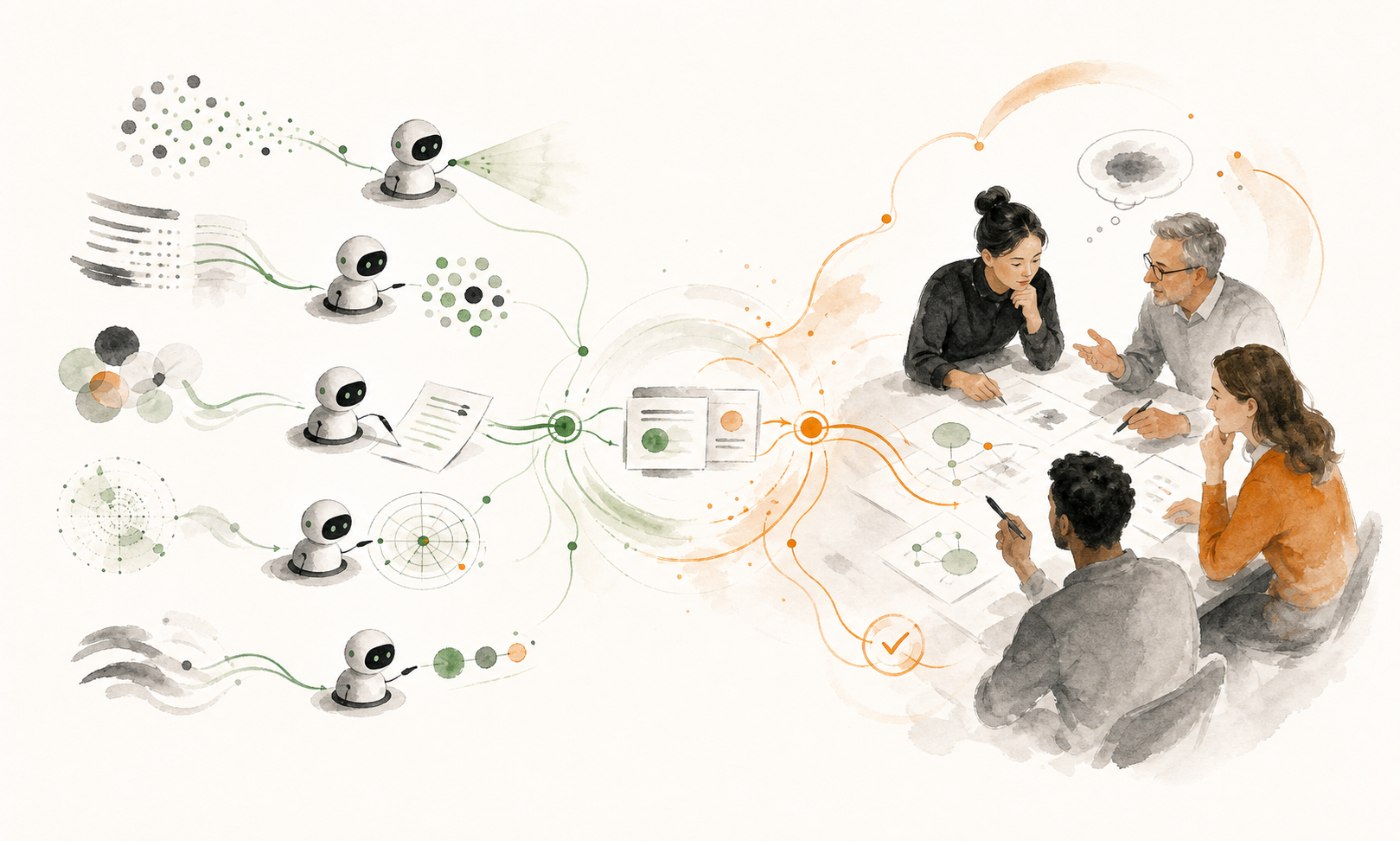
AI handles the scanning. Humans focus on meaning.
AI changes the amount of information a foresight team can process. It doesn’t remove the need for foresight expertise. Finding 500 potentially relevant developments is not the same as understanding which ones matter.
A model does not sit in your strategy meeting. It does not know which assumptions executives are struggling with, which capabilities your organization actually has, or which trade-offs your teams are prepared to make. Those are human decisions.
The useful division of labor is much more practical. Let AI take on more of the searching, collecting, structuring, first-draft analysis, and repetitive updating. Let people interpret ambiguity, question assumptions, bring in internal knowledge, compare perspectives, and decide what to do.
⏵ For a small foresight team, that means covering more ground without multiplying the manual scanning workload.
⏵ For an R&D team, it means keeping a technology radar connected to new technical and market developments rather than revisiting it once a year.
⏵ For an innovation team, it means monitoring an opportunity space after the initial project ends.
⏵ For risk teams, it means repeatedly looking for emerging evidence instead of waiting for the next formal review cycle.
⏵ For strategy teams, it means being able to revisit the future assumptions behind a plan with fresher evidence.
The point isn’t to produce more radar items. It’s to make the radar more useful between the workshops, planning cycles, and decisions it was built to support.
Your foresight radar shouldn’t be an island
Continuous foresight also depends on information moving in and out of the system. Useful signals already exist across organizations: in internal research, expert observations, existing databases, team conversations, reports, external feeds, and specialist sources.
FIBRES is designed to work with that ecosystem.
Teams can bring information into FIBRES through manual inputs, file uploads, web clipping, RSS, APIs, custom feeds, and integrations with other tools and workflows. Foresight Agents can complement those inputs with automated horizon scanning across a large pool of global sources.
The intelligence created in FIBRES can move outward too. Radars and their underlying data can be shared, embedded, exported, and used in presentations and other workflows.
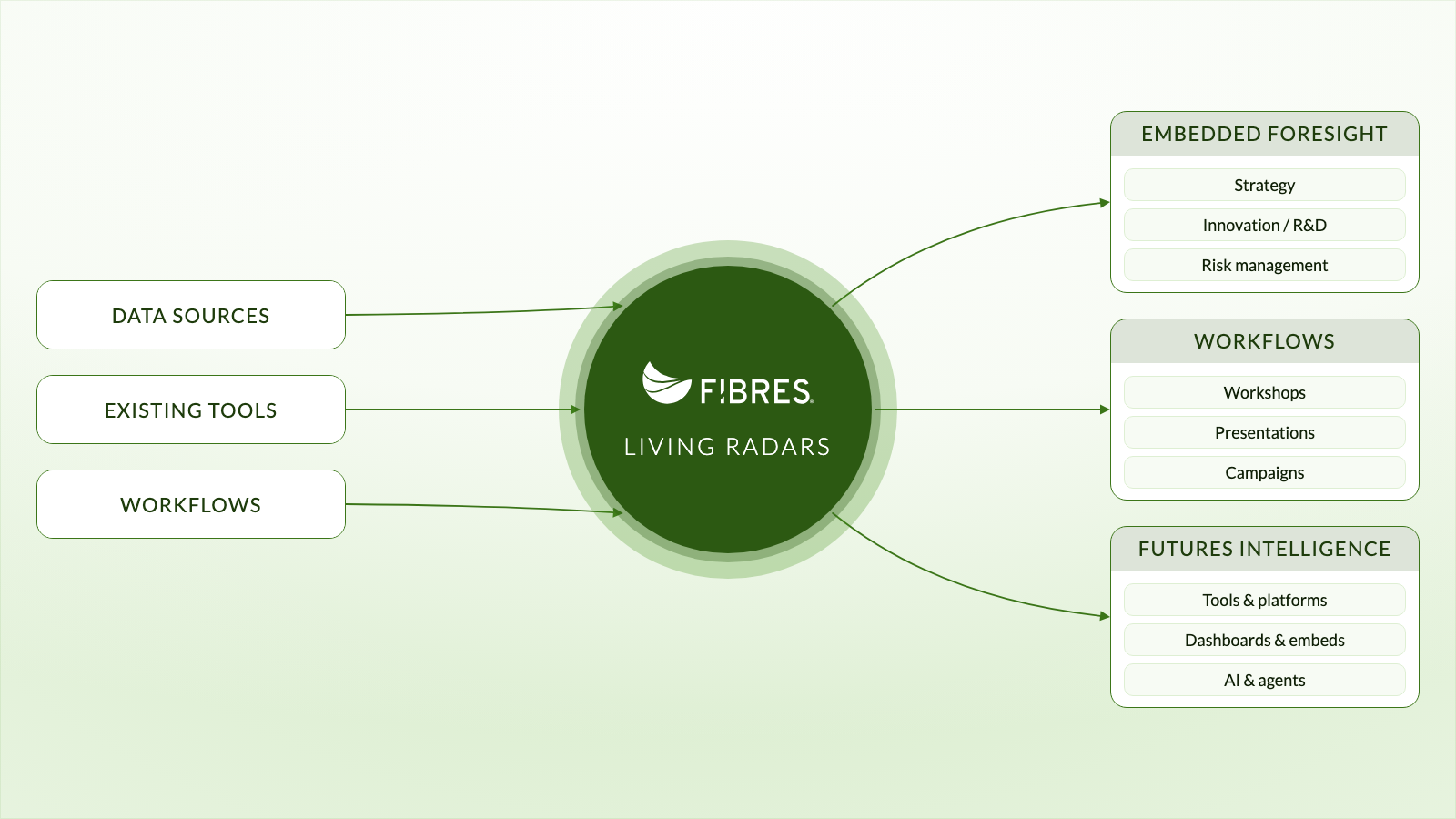
That matters because a radar becomes much more useful when it isn’t a standalone visualization maintained for its own sake. It becomes part of a living foresight system: evidence comes in, people make sense of it together, the radar evolves, and the resulting intelligence flows into the places where decisions are made.
Continuous foresight without continuously adding manual work
The ambition behind continuous foresight isn’t new. The practical constraint has always been the work required to maintain it. Every additional topic meant more scanning. Every additional radar meant more maintenance. Every update competed with the next project for the same limited expert time.
Foresight Agents already changed that constraint. A team can now investigate a new topic without first committing to a large research project. It can build a substantial first draft quickly, improve it with expert judgment, and return later to scan for changes.
That makes continuous foresight realistic for teams that don’t have a large research operation behind them. It also changes what happens to the work you’ve already done. Signals don’t have to disappear into project folders. Radar items don’t have to become slides nobody updates. The evidence, assessments, connections, and organizational knowledge can stay in FIBRES and continue developing as new information arrives.
Over time, the radar becomes more than a deliverable from a foresight project. It becomes a maintained body of futures intelligence. It stays alive.
Want to see what this looks like with a topic that matters to your organization? Book a personal walkthrough of FIBRES and see how to build your own living radars with Foresight Agents.