Many organizations working in strategy and foresight share a familiar struggle. They want to think long term, involve more people, and explore emerging developments, yet daily pressures keep pulling attention back to immediate issues.
Insights accumulate in documents and slides, but rarely form a shared, evolving picture of what might be coming next.
Švietimo tinklas, Lithuania’s national network of education NGOs, understood this challenge well. As an organization deeply committed to shaping a responsive, inclusive, and future oriented education system, they saw the growing need to look beyond short term policy cycles.
As Head of the Network Judita Akromienė explains, “Our long term commitment has always been to strengthen the presence and influence of education NGOs in shaping a responsive, inclusive and forward looking education system in Lithuania. This mission naturally extends into thinking about future education.”
The adoption of Lithuania’s Development Strategy 2050 created the perfect moment to act. Using FIBRES, Švietimo tinklas built the Education Radar: a collaborative foresight environment that now guides strategy conversations, workshops, and cross sector discussions about the future of education in Lithuania.
From scattered insights to a shared Education Radar
Švietimo tinklas had a strong foundation in analysis and advocacy, but until recently their work on the future focused mainly on national level challenges and short range impacts.
As Judita explains, “Our existing perspective was often shaped by historical patterns and policy cycles, rather than by emerging signals or long term shifts.”
With FIBRES, they were able to shift from short term views to a shared foresight system that:
- Helped a distributed community build a collective picture of signals, trends, and megatrends
- Strengthened sensemaking across the whole organization
- Created a living resource to support strategy and policy dialogue
- Made futures thinking part of everyday conversations
The result is a more proactive, informed, and collaborative approach to shaping what comes next for education in Lithuania.
The challenge: a strong mission, but no shared way to explore the future
Švietimo tinklas was not struggling; they were evolving. They had years of experience producing research and thought leadership. They recognized the role NGOs needed to play in strengthening Lithuania’s education system.
What they wanted was a systematic, future oriented way to build on that work.
Prior to FIBRES, the team lacked a single environment where they could compare signals, map trends, and explore long term implications together. As Judita puts it, “We lacked a systematic way to explore future trajectories and possible shifts in the system landscape.”
The need was clear: a method and a shared space that would help them expand from issue driven advocacy into a futures driven perspective.
Why the Education Radar mattered
The Education Radar became that foundation. “Creating the Education Radar was not just an exercise in mapping trends,” Judita explains. “It became a strategic compass.”
The Radar supports Švietimo tinklas as they prepare a new organizational strategy and helps member organizations anticipate emerging needs, identify new opportunities, and engage more confidently in future oriented discussions.
Most importantly, it positions education NGOs not only as respondents to change but as active contributors to shaping the future. In Judita’s words, it helps position civil society “as an active partner in shaping the future of education, not just responding to it.”
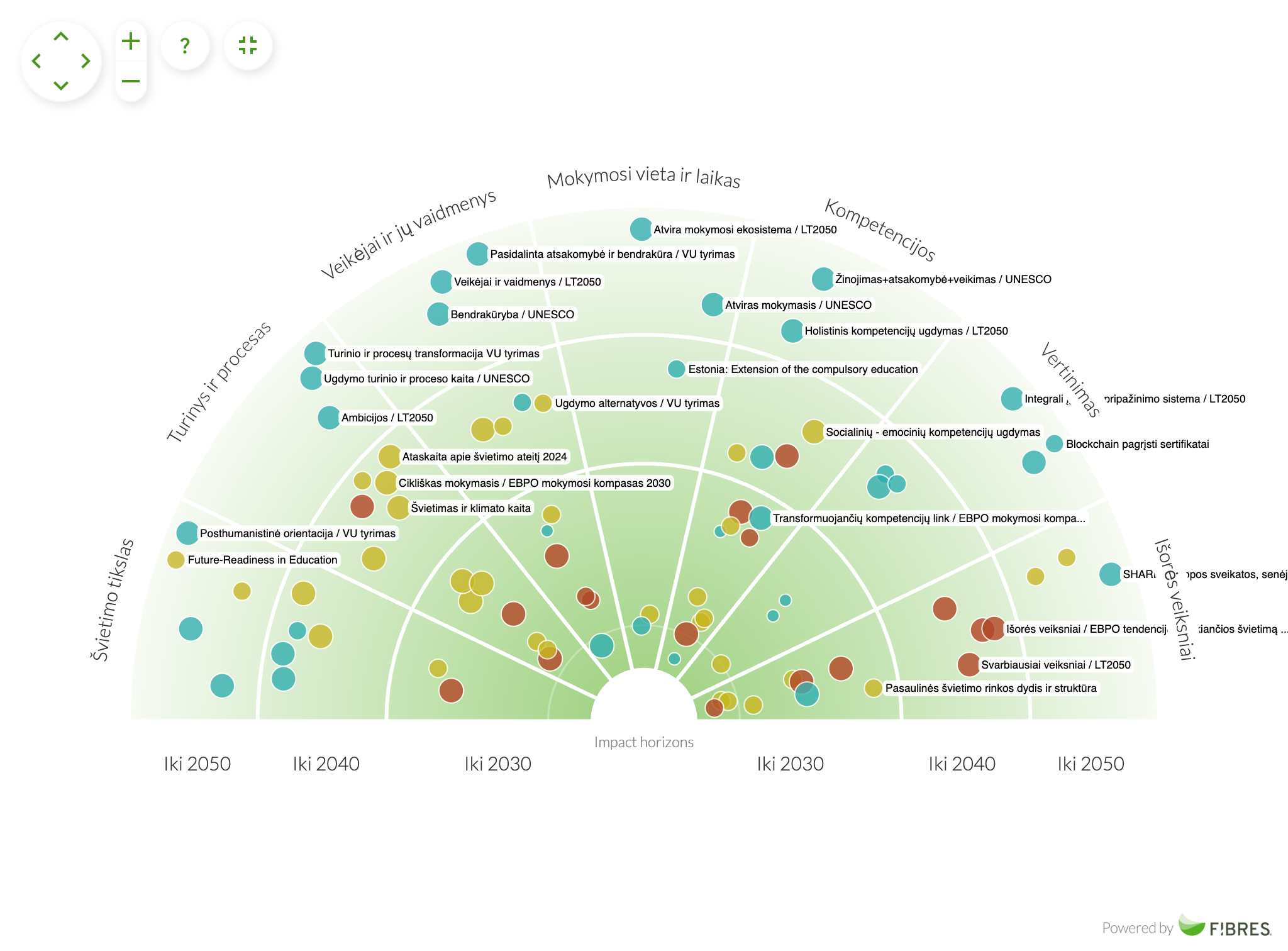
View the live radar (in Lithuanian)
Choosing FIBRES: foresight that feels accessible to everyone
Because Švietimo tinklas was conducting its first structured foresight initiative, they needed a platform that would enable meaningful participation without requiring heavy onboarding.
Judita notes, “FIBRES stood out because of its ease of use, flexibility, affordability, and the opportunity for support when needed.” It allowed the team to work independently, yet still build something “robust and participatory.”
A key insight emerged quickly: FIBRES was not just a repository. It fostered conversation, curiosity, and shared interpretation. “What mattered most in hindsight is that the tool reinforced collective sense making,” Judita says. “It wasn’t just a place to gather data, but a space for team learning and conversation about the future.”
The team also found the platform surprisingly intuitive. “We expected a steeper learning curve,” Judita admits. “This surprised us, and it made the process much more democratic and engaging internally.”
How the Education Radar was built in practice
Švietimo tinklas adopted an iterative and collaborative approach. A core team tested the platform, experimented with structure, and drafted instructions. Then they expanded participation.
“Each contributor added signals, trends and megatrends to the radar,” Judita explains. “Once the information was on the platform, we organised it into thematic groups, dividing sectors among smaller work groups for review.”
This process is ongoing, and intentionally so. The Radar is designed to evolve as new developments emerge and as the team’s understanding deepens.
By working this way, the Radar became more than a static map. With it, in Judita’s words, “we cultivated a foresight mindset across the organisation.”
Before and after FIBRES: a shift toward anticipatory thinking
Even in the early stages, the cultural shift has been noticeable.
“Futures thinking is now part of our organisational language,” Judita shares. Conversations about strategy increasingly include questions like What comes next or How could this trend evolve.
For the team, foresight is no longer a separate project but an enriched way of understanding their work.
FIBRES also enabled something that was previously difficult: moving beyond past-based assumptions. “The Radar encouraged us to identify weak signals and emerging patterns,” Judita notes, which helped the team reframe conversations toward possible futures instead of current constraints.
The result is not only clarity but also curiosity. “Our team is more curious,” Judita says. “They want to explore how foresight can enrich their ongoing work.”
Using the Radar to support workshops and stakeholder engagement
The Education Radar is already impacting discussions across the sector.
Švietimo tinklas recently ran an interdisciplinary workshop on future competences and the role of education agencies. “The Radar helped participants from different sectors find common ground and shared language,” Judita explains.
Upcoming conversations with policymakers will also draw from the Radar, grounding short term decisions in long term national goals. This helps create more constructive, future oriented dialogue.
A living resource for strategy, collaboration, and long term impact
The Education Radar is now becoming an integral part of the organization’s planning and partnerships. “Looking forward, we aim to embed foresight in our organisational strategy and external partnerships,” Judita shares. The Radar will guide annual planning, project development, and advocacy.
For Judita, the greatest achievement is seeing foresight move from theory to practice. “It’s no longer just a conversation among a few,” she says. “It’s a framework that supports deeper thinking and collaboration across organisations that care about the future of education in Lithuania.”
What this means for other foresight, strategy, and innovation teams
Švietimo tinklas illustrates an important point: you do not need a large team or extensive foresight expertise to build a meaningful futures intelligence system. What matters is having a clear purpose and a tool that makes participation easy and structured.
With FIBRES, teams can:
- Create a shared home for signals, trends, and insights
- Build foresight collectively, without losing coherence
- Turn futures thinking into a practical, ongoing part of strategy
Even first time foresight teams can move quickly from scattered materials to a living foresight system that grows with them.
Ready to build your own living foresight system?
If you want to go from reactive conversations to a shared, actionable understanding of what comes next, you can do it faster than you think, as proven by Švietimo tinklas.
FIBRES helps teams create their own living foresight systems and radars for strategy and any other foresight need, without complex setup or deep technical training.
You can start small, involve colleagues right away, and build futures intelligence that becomes part of your organization’s daily language.
If you would like to see how this could work for you, request a walkthrough of FIBRES. We will show you how strategy, foresight, and innovation teams are building collaborative foresight environments in weeks, not months, and how you can do the same.